Showing posts with label aesthetic. Show all posts

Tuesday, September 13, 2016

The O'Neill Dilemma

Eugene O'Neill's father James was a famous actor. He played Macduff opposite Edwin Booth in Macbeth, and was a renowned Romeo (onstage and off). But he was best known for his role in The Count of Monte Cristo, a part he played regularly over more than forty years. It wasn't long before his popularity in the role became a trap. The San Francisco News Letter complained that his performance had "degenerated" from art to mere commerce. O'Neill tried to turn to other works - notably Julius Caesar - but when those flopped financially he found himself back in The Count to recoup his lost money. Thanks in large part to his son's retelling of the story, O'Neill's dilemma has become a warning trope to actors who repeat a role: This way lies artistic peril.

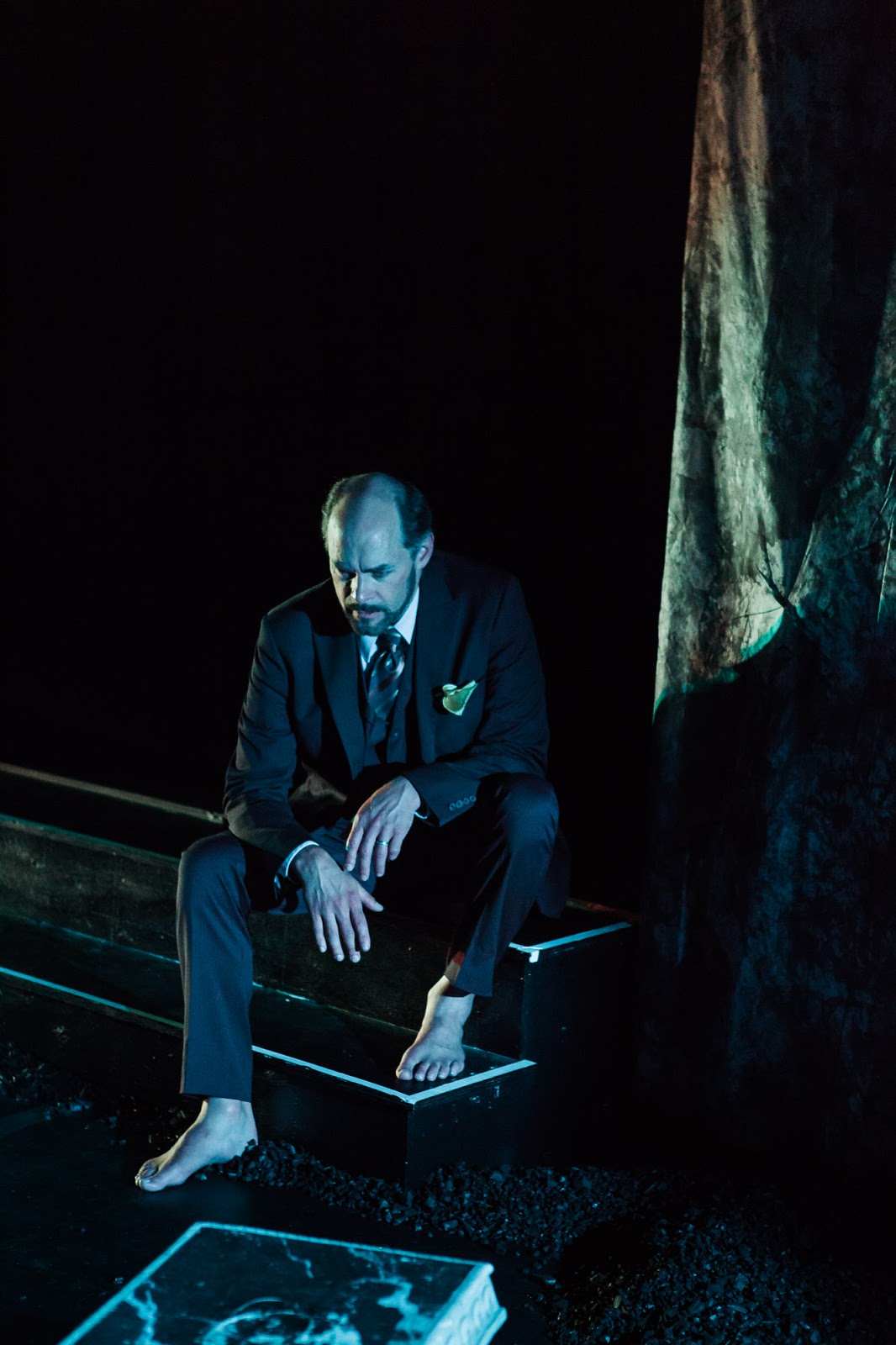
theatre KAPOW just completed its fifth production (in four years) of The Burial at Thebes, Seamus Heaney's adaptation of Sophocles' Antigone. Each year we remount our production for Saint Anselm College, as part of the College's Conversatio course for first-year students. The production helps us pay the bills for the rest of the season. Four of our company have appeared in the same roles in all five productions. Yet with some effort on all our parts, we have avoided the artistic peril.

This summer during our annual retreat at Chanticleer Gardens we dedicated five class sessions in what we called the Michael Chekhov Practicum to rehearsing just the first scene of Antigone, each day from a different starting point in the actor's art: psycho-physical center, quality of movement, atmosphere of place, expansion and contraction, rising and falling. Apart from the pure joy of exploring a great story, we learned that the first scene alone remains full of new possibilities for us. We haven't come close to plumbing the depths of the Antigone story.

A month later we began formal rehearsals for this latest production. The design and staging elements remain largely the same. But the four actors who were returning for the fifth time each found a newness in the work. Each of us had the experience of hearing or seeing something in a new way, and thus each of us could realize new relationships and possibilities. For me that was the result of a new starting point. If last year was all about what Chekhov called psychological gesture, this year began with the atmosphere of corruption, and the corruption of flesh and morals that runs through the play. That atmosphere generates an odor, an imagined sensation on the skin, and a visceral experience of corruption. That experience of the atmosphere led me to an enhanced understanding of Creon's action through the play. He's not only "saving the city;" this year he's purging the corruption, and again that action carries him from the beginning of the play to the very end. The experience of atmosphere led also to a new quality of movement - less flying this year, and more molding. And then to a new experience of psychological gesture that develops from expanding and contracting in the atmosphere. Purging is a kind of expansion; the defense against or retreat from corruption is a kind of contraction. And those new or refined gestures led further, to a new consideration of archetype. This year, Creon is not so much a king as he is a priest (who else has the work of saving the people or purging the corruption?). Antigone, in my mind, becomes a priestess, or nun, or sacrificial virgin. And thus we arrive - in fairly rapid fashion - at a deeper layering of the relationship between the two characters.

Of course we still encounter the usual troubles that plague almost every production in almost every company - too little time to rehearse, uncertainty about the receptivity of the young audience (which this year was superb), and so on. But the lesson of this year's remounting, and of all great plays, is that we never really "close" a production, or "put to bed" a great role. We've discovered that there's a lot of work left for us to explore in this story, and that as we continue to incorporate trainings with rehearsals we can avoid "the O'Neill Dilemma." Next year's Thebes won't be a mere repeating of the old chestnut for us, but the opportunity for our deepest artistic growth.

~Peter Josephson

Wednesday, January 6, 2016

2016 Resolutions

It's that time of year: the gym is crowded, various diets and cleanses are all the rage. Everyone is "turning over a new leaf" for the new year. We thought about some things we'd like to be sure to do in 2016, and here's what we came up with:

1. Engage audiences in the process
Last season we began a series of special engagement opportunities with our donors and audience members. The process of creation is often very private, but theatre is a collaborative experience. The cycle of sharing, discussing, revising, sharing again and continuing the discussion is at the heart of the rehearsal process. We’d like to widen the circle of participants and provide a deeper experience for audience members in 2016.

2. Experience the work of other companies
Re-stocking the well is an essential part of creative life. Sometimes that means setting aside time to read a book or color in a coloring book. One source of great inspiration and fuel for the fire/desire to create good work is to see good work. Be it dance, theatre, music, or visual art, in 2016 we want to see good work and share it with others. We’ll plan a series of “field trips” to re-stock our well and inspire our creativity.

3. Train with visiting artists
Over the course of the past several years we have hosted visiting artists as part of the annual Artists’ Retreat at Chanticleer Gardens in Dunbarton and have twice hosted trainings led by visiting artists at our studio space in Manchester. In 2016, we seek to expand training opportunities in both locations. A commitment to rigorous training has been integral to tKAPOW’s work since the beginning, but we believe that a critical aspect of our future success will be learning more about different approaches to theatre making. With this in mind, tKAPOW will plan and schedule a series of pay-as-you-go training experiences for local theatre artists.

4. Provide artists with opportunities to expand their own training
As mentioned above, training is an important piece of tKAPOW’s identity. Something that we’d like to do in 2016 is to make funding available to allow artists who work with tKAPOW to take part in training with other companies or in complementary fields that we believe may benefit future tKAPOW productions. So, attend a theatre workshop, take lessons in a certain instrument, or practice circus skills as part of an aerial silks class, we hope we can help pay for it. We want to encourage our artists to gain skills that will add to future productions.

5. Incorporate music into our work more fully
Truthfully this is one of those resolutions that I put in the list every year. Working with Sandy on The Burial at Thebes and Dave on Macbeth really added a great deal of texture to those productions and we are excited to find other ways to integrate music more fully into future productions. With Raining Aluminum, the new piece that we are premiering in June 2016, we are collaborating with Cynthia MacLeod, a fiddler from PEI. It will be fascinating to see how Cynthia’s work on the soundscape for that piece influences the storytelling. I look forward to exploring ways that music can be used in new and perhaps unexpected ways to improve our work.

6. Expand our audience base by performing in new locations
In 2015, we were fortunate enough to perform in Manchester, Derry, Concord, and Portsmouth. Everywhere we went we met new people who truly enjoyed our work. In 2016, we are already scheduled to do a workshop in Boston and I look forward to finding new performance venues. In September, we met with a number of presenters from Canada about performing up there so who knows maybe we’ll be visiting Tim Horton’s instead of Dunks when we need a caffeine boost in the new year.

7. Create a “bring-a-friend” program to introduce new audiences to our work
We know that our audience members are the best advocates for our work. We hear such lovely feedback following performances both in person and online. We want to find a way that you can share tKAPOW’s shows with a friend and get some benefit out of it. Whether that is a reduced ticket for yourself, a buy-one-get-one offer, or some kind of loyalty program, I don’t know yet, but we’d love your help in introducing more people to what we are doing.

8. Increase participation in Open Training
Just today, we fell down a YouTube hole of watching clips of Wheel of Impressions from The Tonight Show. Both the musical editions and the one with Kevin Spacey (which is a master class in vocal work itself, you should watch it) reminded me that training, training, training is so essential to creating good work. Training your ear, training your voice, training your mind, training your body: these are the tools of the craft. To excel at your craft, you need to train. It’s not about having great physical prowess or building incredible strength or inhuman flexibility. It’s about training your instrument to do what you need it to do when you need to do it, so that you can get out of your own way and be in the moment. In 2016, we will continue to share the trainings we practice, and new trainings that we find.

9. Research and learn more about the world in which we live and work, approaches to theatre creation, understanding of cultures with which we are unfamiliar.

At this time of year we often spend a lot of time reading. We read a lot of scripts, yes, but we also read about different training methodologies, philosophical texts, books on textual analysis, and the occasional book that seems unrelated to anything (Banana: The Fate of the Fruit that Changed the World and I Am Malala are on the pile this year). It is part of tKAPOW’s mission to present great works of dramatic literature from across ages and cultures, but it never really feels like we have dug deep enough. The world is a big place and, the more we learn about different cultures, the more we understand the universality of the human experience. In 2016, we must travel more, read more, and meet more people who can help us tell the stories that need to be told.

10. Recommit to our aesthetic
We talk a lot about what makes a tKAPOW show a tKAPOW show and always end up back at the same place, aesthetic. So many great artists have contributed to shaping that aesthetic over the years and, in 2016, we will continue that work to define who we are as a company through the way that we produce work. Intimacy remains a key element of our aesthetic, as does accessing character through physicality, approaching all production elements artistically, and--I hope--endeavoring towards ingenuity. This is truly the work of a lifetime, an un-achievable resolution that will nonetheless remain forever a goal for this company, in 2016 and for many years to come.