Showing posts with label performance training. Show all posts

Sunday, February 12, 2017

What the hell is going on?

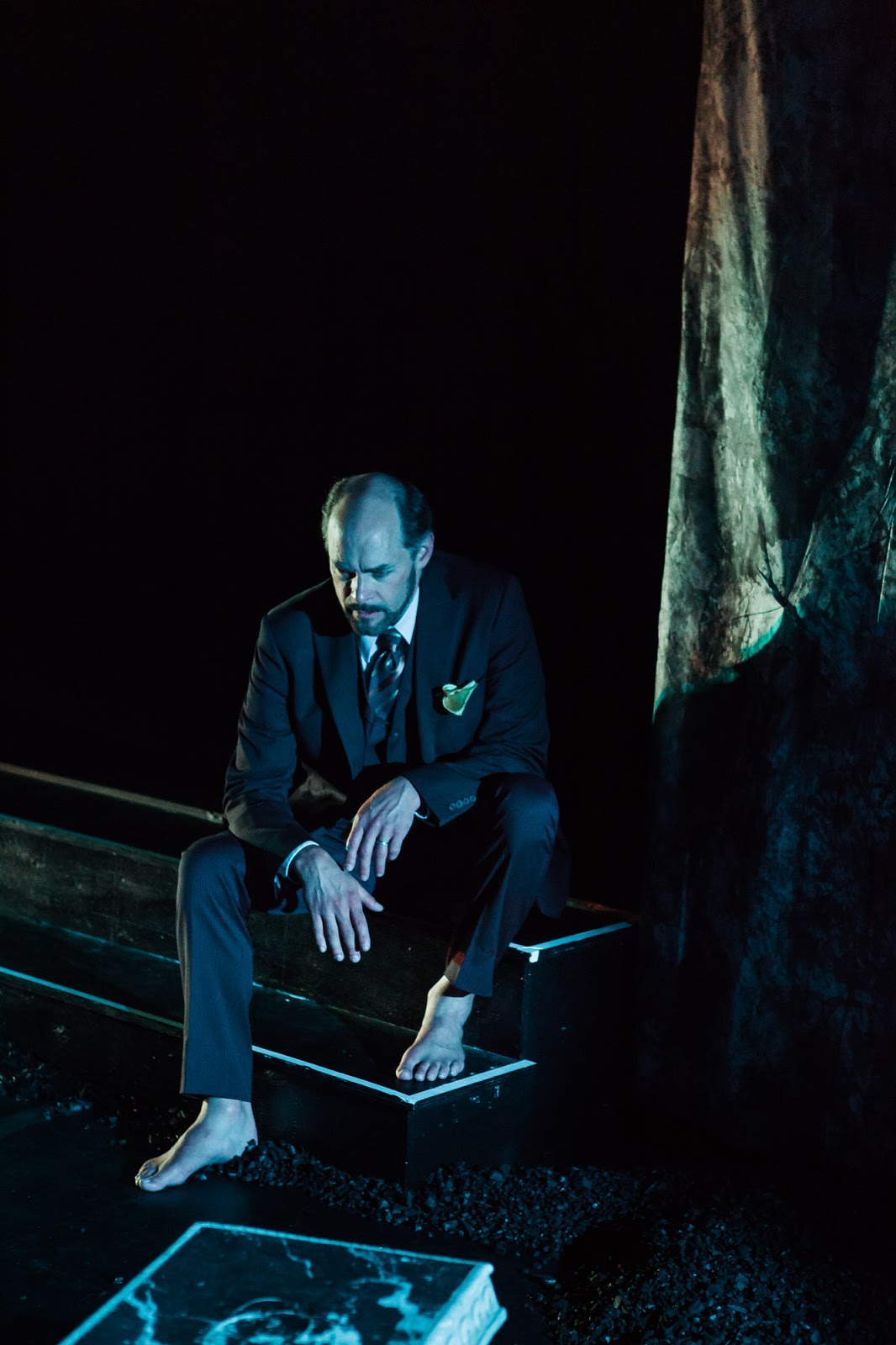
This was the over-riding thought I had when I finished reading Exit the King. Ionesco's writing, I knew, like Beckett, like Sartre, can be esoteric and difficult to decipher. "Avant-Garde." "Absurd." "Didactic." In other words: inaccessible. I would be lying if I said I did not agree with some of these labels, especially during my reading of the play. For every insightful notion, there was a confusing one. At one moment I would be inspired by the eloquence of his language, at another irritated by his apparent pretentiousness. This is most certainly a play meant to be seen, not read, I thought to myself. It needs to be on its feet! We need our read through!

What the hell is going on??

Boy was I wrong. Upon completing our cast read through, I not only was left feeling similar to how I felt after reading the play, but if anything, I had more questions! I had suspected Ionesco would be daunting, and yet here I was feeling like years of performing theatre had left me utterly and singularly unprepared to turn these words into something resembling a coherent performance. Luckily, it appeared to me that I was not on an island in my thinking. Here were artists I respect and admire, and we all seemed equally humbled by how truly massive this text is.

If you had asked me what I thought our rehearsals held in store, I likely would have responded: Frustration. Confusion. Doubt. Or perhaps some combination of the three.

Fast forward four weeks.

What do I find dominate my memories of rehearsal thus far?

Tears of laughter. Barely concealed grins. Countless (failed) attempts to remain in character. These have been found in abundance through our rehearsal process. I believe this is due to a critical discovery made early in the process.

We discovered, that buried underneath a masterfully written political commentary, Ionesco has written a very funny play. This is our password. Our Rosetta stone. Because at the end of the day, Ionesco's wonderfully relevant text is useless if the audience does not connect with it. But because he was really, really smart; he wrote the key into the play.

Find the silly. Find it, and embrace it.

Laughter has the wonderful power to bring people from all walks of life together in a shared experience. This is intensely needed, in a time where people live in digital echoing chambers and spend their time dehumanizing "the other team." That is to say, anyone with different opinions.

One does not grow by hearing their own preconceived notions repeated back to them covered in sugar. One grows by honestly listening to someone who thinks differently. Who believes differently. One grows when one sincerely tries to step into their shoes. One grows when one realizes that "the other team" are human beings. Human beings that breathe oxygen, human beings that cry when they get hurt, human beings that just want to be happy.

Human beings that laugh.

That is what this play needs to do. It needs to invite the audience in. Reach out a hand, a genuine offer of inclusion. The production should invest and respect the audience as fellow human beings capable of rational thought.

This connection is made by showing them the silly, absurd things human beings do. But then show them the worst and best in all of us.

That inside every human being lives a great leader, with the power to inspire millions with a word. But inside every human being also lives a tyrant, who cultivates fear and dissent through propaganda and manipulation.

Inside every soldier lives a hero, who saves lives without regard for their own and stands up to injustice. But inside every soldier also lives a pawn, who only follows orders, and lets fear rob them of their spirit.

Inside every heart lives a lover, who puts their heart in the hands of another human being, risking shame, humiliation and pain for the chance at true happiness; who lets the one they love inspire them to be better, stronger, kinder. But inside every heart also lives a skeptic, who distrusts the world and lashes out with insecurity and fear. Fear of shame. Humiliation, Pain.

Inspiration. Fear. Heroism. Impotence. Happiness. Pain. In other words, being alive. This play shows what it is like to be alive. That we are all capable of greatness. That we need to strive for it. That we need to be better.

Be better.

~ Jimmy Stewart

theatre KAPOW presents Exit the King by Eugene Ionesco March 3 - 5, 2017


Wednesday, December 14, 2016

Reinforcing Time

This past weekend, I attended Shakespeare & Company’s Boston Weekend Intensive. I highly recommend these weekends. They are affordable, and can fit into the crazy schedule of theatre/work/life/family without requiring too much of a sacrifice from any one of those areas.

Each meeting of this intensive begins with 13 chairs in a circle for each of the twelve participants and the teacher, Dennis Krausnick. The first night, we check in with four things: our name, the landscape of our childhood, our heart’s desire for the weekend, and something we would not normally tell a group of strangers. My heart’s desire for this weekend was to focus on myself. I am always providing opportunities for others, and I rarely get to focus on myself as an artist and restock my well. I wanted to leave my phone and all it represents in the greenroom for the weekend and be selfish. That was my heart’s desire.

After the check-in and a short break, we did an exercise focusing on becoming present in the space, starting to connect with our own breath, and making eye contact with the other participants. This shifting into an exercise inviting our past selves a chance to be present with us: 5 years old, 9 years old, and 13 years old. Each of these ages informed a delivery of our monologue (we had each memorized 14 - 25 lines of Shakespeare to work with over the weekend.) At the end of the night, we gathered the 13 chairs in a circle again to name a discovery or idea we wanted to reinforce over the rest of the weekend. I want to reinforce permission: the permission to be free to explore the present and play again.

On day 2 after a check-in of what stuck with us from yesterday and what we discovered from our homework (yes, there is homework for an intensive even when you get out at 9.40 at night!), we spent the morning on delicious voice work. What a truly lovely way to spend the morning. Breath, body, vibration: all things I work on in my daily practice but I had been rushing over. Practicing just to check it off the list of things done for the day. How wonderful to return to those very basic things and to really tune in to discovering my own habits and whether they truly serve me or not.

The afternoon and evening were spent observing and working individually with Dennis on the text we had prepared. Such wonderful text and characters: Cressida, Hermione, Paulina, Imogen, Edward, Helena. As each person connected the monologue to their own personal life experience, and as he worked patiently with each person to find their breath and release the words using that breath, the true power and beauty of this weekend and these actors came forward. We gathered our chairs in a circle to check-out at the end of the night, and we again said out loud a discovery or idea to reinforce for the weekend. I want to reinforce working without judgement: judgement of myself and assumptions/judgements of others.

Day 3 began with the usual check-in, with the added item of the question “did we have any remorse about anything we had shared yesterday?” This led to a wonderful discussion of drama therapy vs. personal connection, what are professional boundaries, and is personal tragedy required for one to be an actor? An important discussion indeed, which led to a great deal personal thinking on these questions. After a morning of voice work bringing breath, vibration, and presence to our chosen text, the focus for the afternoon shifted to setting Shakespeare in the context of his place and time, and looking at why the First Folio is important and what actors can learn from it. I was reminded of the words of another artist I greatly admire, Ellen Lauren: “The teachers of this work are leaving this world,” and I was so grateful to be learning from 79-year-old Dennis Krausnick. My notes on punctuation, capitalization, long spellings and two universes are so poignant and helpful, and I am grateful for his generosity in sharing his ideas and the fruits of his lifetime of experiences and learning.

After each person shared more discoveries from their chosen text, we gathered our chairs in a circle one last time for a final check-out. What were we going to take away from this weekend intensive? I want to reinforce Time, taking my time. Why am I already learning my lines for my next project: I will take time to fully explore my connections to the text, and take time in rehearsal to be present for true connections with my ensemble. I will take the time to breathe and to make eye contact: what is each person bringing to this story and how do I respond to that?

Theatre is important because we gather together there to hear and to tell stories. I will take my time and be a better listener and a better storyteller.

Thank you to Kirsten, Caitlin, Srin, Deborah, Nancy, Laura, Peter, Meg, Britney, Lei, and Julia for sharing so much this past weekend. And thank you especially to Dennis Krausnick for your generosity as a teacher, an artist, and as a human.

~ Carey Cahoon


Tuesday, September 13, 2016

The O'Neill Dilemma

Eugene O'Neill's father James was a famous actor. He played Macduff opposite Edwin Booth in Macbeth, and was a renowned Romeo (onstage and off). But he was best known for his role in The Count of Monte Cristo, a part he played regularly over more than forty years. It wasn't long before his popularity in the role became a trap. The San Francisco News Letter complained that his performance had "degenerated" from art to mere commerce. O'Neill tried to turn to other works - notably Julius Caesar - but when those flopped financially he found himself back in The Count to recoup his lost money. Thanks in large part to his son's retelling of the story, O'Neill's dilemma has become a warning trope to actors who repeat a role: This way lies artistic peril.

theatre KAPOW just completed its fifth production (in four years) of The Burial at Thebes, Seamus Heaney's adaptation of Sophocles' Antigone. Each year we remount our production for Saint Anselm College, as part of the College's Conversatio course for first-year students. The production helps us pay the bills for the rest of the season. Four of our company have appeared in the same roles in all five productions. Yet with some effort on all our parts, we have avoided the artistic peril.

This summer during our annual retreat at Chanticleer Gardens we dedicated five class sessions in what we called the Michael Chekhov Practicum to rehearsing just the first scene of Antigone, each day from a different starting point in the actor's art: psycho-physical center, quality of movement, atmosphere of place, expansion and contraction, rising and falling. Apart from the pure joy of exploring a great story, we learned that the first scene alone remains full of new possibilities for us. We haven't come close to plumbing the depths of the Antigone story.

A month later we began formal rehearsals for this latest production. The design and staging elements remain largely the same. But the four actors who were returning for the fifth time each found a newness in the work. Each of us had the experience of hearing or seeing something in a new way, and thus each of us could realize new relationships and possibilities. For me that was the result of a new starting point. If last year was all about what Chekhov called psychological gesture, this year began with the atmosphere of corruption, and the corruption of flesh and morals that runs through the play. That atmosphere generates an odor, an imagined sensation on the skin, and a visceral experience of corruption. That experience of the atmosphere led me to an enhanced understanding of Creon's action through the play. He's not only "saving the city;" this year he's purging the corruption, and again that action carries him from the beginning of the play to the very end. The experience of atmosphere led also to a new quality of movement - less flying this year, and more molding. And then to a new experience of psychological gesture that develops from expanding and contracting in the atmosphere. Purging is a kind of expansion; the defense against or retreat from corruption is a kind of contraction. And those new or refined gestures led further, to a new consideration of archetype. This year, Creon is not so much a king as he is a priest (who else has the work of saving the people or purging the corruption?). Antigone, in my mind, becomes a priestess, or nun, or sacrificial virgin. And thus we arrive - in fairly rapid fashion - at a deeper layering of the relationship between the two characters.

Of course we still encounter the usual troubles that plague almost every production in almost every company - too little time to rehearse, uncertainty about the receptivity of the young audience (which this year was superb), and so on. But the lesson of this year's remounting, and of all great plays, is that we never really "close" a production, or "put to bed" a great role. We've discovered that there's a lot of work left for us to explore in this story, and that as we continue to incorporate trainings with rehearsals we can avoid "the O'Neill Dilemma." Next year's Thebes won't be a mere repeating of the old chestnut for us, but the opportunity for our deepest artistic growth.

~Peter Josephson

Sunday, August 16, 2015

Season 8:breathe

Dream. Awake. See. Breathe.

There are so many reasons that breathe makes a fitting and wonderful theme for season 8. The Latin word spiro, to breathe, gives us the English word inspiration. And the related word spiritus means breath, the soul, vigor, that which animates life. The breath provides a return to the most basic thing that makes us alive.

Kristin Linklater gives a wonderful tip which applies to both the artistic life and quotidian life: “Do fall in love with your breathing. It's you. It's your emotions. It's your voice. It's not a machine." Frequently at our open trainings, we talk about the importance of returning to the basics of training, including voice and the breath. Season 8 will be a good season to reinforce that message and to connect respiration directly to the work on stage.

It is a very busy season with, ironically, few opportunities to come up for breath. We start off very early in September by returning to Seamus Heaney’s The Burial at Thebes for a fourth time. The production will be September 8th, 9th, and 10th at the Dana Center at Saint Anselm College. While it is a piece that we have explored a number of times, we always try to add new elements. This year we’ll be incorporating some puppetry including a brand new marionette that we had made specifically for the production by a carver in Prague.  

The first weekend of October (2nd-4th), tKAPOW will present Duncan Macmillan’s beautiful play Lungs. Lungs tells the story of a young couple living in a time of global anxiety, terrorism, erratic weather, and political unrest, who wants to have a child but are running out of time. If they over think it, they'll never do it. But if they rush, it could be a disaster. Macmillan expertly balances humor with heartbreak and really poses questions about how we can live (and love) in a world as tumultuous as ours.

For Halloween we’ll return to yet another familiar piece as we remount our award-winning production of Macbeth. Shakespeare’s famed “Scottish Play” as interpreted by three actors using minimal props and costumes. An audience member who saw the show last year commented,”The production had an amazingly guttural (raw) feel to it; the energy of the production was palpable.” This year, we’ll be taking the show to two venues where tKAPOW has never performed: Seacoast Repertory Theatre (October 29th-31st) and the Capitol Center for the Arts (November 6th).

The very popular ARTiculate playreading series at the Currier Museum of Art is now in its third year and will continue this year with two readings. The first play Bakersfield Mist by Stephen Sachs will be read December 13th. In this very funny new play, when it turns out that a thrift store gag gift may in fact be a long-lost Jackson Pollack painting, an expert is brought in to determine its authenticity. In March, tKAPOW will be reading Filming O’Keefe in relation to a piece in the Currier’s permanent collection: Cross by the Sea, Canada 1932, by Georgia O’Keefe. The play explores the relationship between O’Keefe and Alfred Stieglitz through the lens of a school project. The funny but poignant play explores the bonds of familial relationships as a teenage boy seeks to uncover his family’s hidden past.
After the success of 2013’s Penelope, tKAPOW is pleased to once again present a wonderful piece of contemporary Irish dramatic literature with Marie Jones’ Stones in His Pockets. This Olivier Award-Winning play (Best New Comedy, 2001) tells the story of a movie location shoot in Ireland, and the delightful, touching characters caught up in it. The piece is a comic tour-de-force for two actors who play all 15 roles. Not to be lost in the quick changes and ridiculous situations is a play with tremendous heart. Stones in His Pockets will be presented February 26th-28th at the Stockbridge Theatre.

In April, tKAPOW will return to the Currier for some very special events. tKAPOW, was part of a group of arts organizations and educational institutions that has come together to host a copy of Shakespeare’s First Folio. As part of the folio’s visit to NH, tKAPOW will be performing a selection of Shakespeare scenes (April 21st) and leading an educator workshop (April 23rd) at the museum.

May is a very busy month for tKAPOW. At the beginning of the month (April 29th-May 1st), we’ll be presenting George Brant’s explosive one-woman play Grounded. When an unexpected pregnancy ends an ace fighter pilot’s career in the sky, she is reassigned to operate military drones from a windowless trailer outside Las Vegas. She hunts terrorists by day and returns to her family each night. The play, which just completed a very successful New York run featuring Anne Hathaway, asks questions not only about the nature of modern warfare, but about its impact on families at home.

In mid May, tKAPOW goes on the road once again. This time we’ll be headed to the Charlestown Working Theatre in Boston to spend a week workshopping a new piece tentatively entitled Raining Aluminum. The piece weaves together the parallel storylines of the 1917 explosion in Halifax Harbor (and the corresponding American relief efforts) and refugee stories from Operation Yellow Ribbon (the Canadian response to the terrorist attacks on 9/11). While these two moments in history are often associated with great tragedy, Raining Aluminum seeks to highlight the tremendous instances of gratitude and the strength of human spirit. We are so thrilled to be collaborating with some fabulous artists on this project including the Czechoslovak American Marionette Theatre and world renown PEI fiddler, Cynthia MacLeod. The piece will be workshopped in Boston May 15th-21st in advance of the world premiere production at the Opera House in Derry June 24th-26th.

It will be a very busy season and one full of great theatre. In the words of the Buddhist monk, Thich Naht Hanh, “Smile, breathe, and go slowly.” A mantra for this busy season indeed.

Wednesday, January 28, 2015

The Necessity of Theater


Over the past few weeks, I have been reading The Necessity of Theater by Paul Woodruff. An excellent philosophical text, it challenged me to rethink what I define as theater, and what I define as good theater. Among other wonderful points, Woodruff asserts that theatre - the experience of watching and being watched - develops empathy. As watchers of good theatre, we are drawn to stories of characters that engage our emotion. This is not limited to “good” characters as opposed to “evil.” The capacity to pay attention to others for their own sake, is the basis of good ethics. This, he concludes, is what makes theatre necessary in our world. We practice the capacity to pay attention to others for their own sake, or more simply, to care about others. “When truth is spoken in theater, theater can show us what it is like to be the person who believes this truth.”

I am an avid reader of texts about theatre, acting, and performance technique, and a reader of plays. In The Necessity of Theater, Woodruff reminds me that reading a script, a “literary study”, is not the same as seeing a production. It is a valuable experience, but a very solitary one. In a similar way, the primary difference between theatre and film or television is the exchange of energy between actors and audience. The words on the page are stagnant, the carefully designed point of view of the film never changes. A script may be printed and notated, but for any given performance, the community of actors and audience members gathered in that place and in that moment of time is unique. The performance is ephemeral and is a unique yet shared experience. From this comes the value, the necessity of theater.


I am a theatre artist who believes in the importance of training, of practice. How can I “train” the capacity for empathy, for caring for others? How can I practice the crucial capacity for understanding and connection, and therefore for community? One of my goals for this year is to see good work more often, and thereby to develop the skills of being a good watcher, an active and engaged audience member. I believe that this will make me a better artist, and a better human being.
~ Carey Cahoon

Sunday, December 28, 2014

Back to basics

My daughter’s dance school posted this thought a few weeks ago: “Beginning dancers prefer to take Intermediate Level classes; Intermediate dancers prefer to take advanced level classes; Advanced level dancers take private lessons to work on the basics.”


This quote stuck with me and I have been thinking about it a lot over the last three months. The process of studying, learning, exploring, and creating our production of Macbeth was incredibly daunting and humbling. I often felt myself lost in the complexity of Shakespeare’s language, character and story; and having to keep up with my fellow ensemble members.


When I finally had time to catch my breath between the first production and the re-mount, I pulled a book off my shelf to re-read: The Practical Handbook for the Actor. It doesn’t take long to read the book, but I have underlined so very many things in it. I pulled out the notebook from my summer at the Atlantic Acting School, and laughed to look through all the attempts to analyze the short scenes we were working with in our classes.  Pages and pages of Literals, Wants, Actions, and As-ifs; crossed out, re-drafted, written over again with a different word choice. I scrapped the analysis I had settled on for the performance of Macbeth, and started the process all over again, only to go back to what I had before.  It is so complex, but so simple.


Around the same time, my mother-in-law gave me two books by Cicely Berry for my birthday. Coincidentally, Voice and the Actor is on the list of recommended reading at the back of Practical Handbook. Somehow, I had never read her work, but am finding as I read that it really resonates (pardon the pun) with me right now. For several weeks during this very busy fall, I had gotten away from my routine of daily voice and speech practice. Even when I had been doing those practices, I found myself going through the motions and not working with awareness and attention. For the last ten days, I have allowed myself the luxury of at least five minutes every morning just to breathe. With all of my energy and attention focused on just that.  It is so complex, but so simple.


I’ll slowly start a return to my full vocal practice, getting into more detailed work, playing with new-to-me texts and exercises.

But for now, I am more than happy to take the time to work on the basics.

~ Carey Cahoon

Monday, September 1, 2014

Learning to Learn in the Present Moment

This summer was our third Artists Retreat, concluding just a few weeks ago. Why do we go there for a week each year right at the start of the season?
Continued study has always been a core tenet of our company. Eugenio Barba writes of the phenomenon he calls learning to learn. "This is of tremendous importance for those who choose or are obliged to go beyond the limits of specialized technique. It is the condition that enables us to go beyond technical knowledge and not be dominated by it." As we experience and learn from on-going theatre trainings, we wanted to share our disparate methods with one another. Peter, through a series of events and meetings only to described as synchronicity, was introduced to the owners of Chanticleer Gardens, an idyllic flower farm. So Matthew said, "Let's go to the farm all day every day for a week, share, and see what comes of it."
In addition to sharing our own methodologies of the Michael Chekhov training, psychophysical improvisation, and Viewpoints, we brought in guest artists to lead workshops in modern dance, poi spinning, Lessac Kinesensic training and more. What we discovered, and continue to discover every year, is that the similarities and commonalities among all these practices far outweigh the differences. All of them seek truth, a unity of something both inside and outside the self, which is recognizable beyond culture, medium, or even time.
For the last two years Aaron Butler, a master of several martial arts who teaches at The Training Station in Manchester, NH, led a workshop in Tai Chi and I Liq Chuan. This work became some of the most profound of the retreat for me. At the core of both practices is developing a mindfulness and awareness to the present moment. The vocabulary is different, but the ideas the practice is driving toward are familiar. Aaron's teaching reminds me that there is so much in this world that I don't know, there is so much I can learn.
This summer we had a new guest artist, Valentina Lattuada from Barcelona, Spain, who shared her work which she calls Integral Transpersonal Theatre. I prefer the alternate name she uses - the Poetics of the Invisible.  Her work began, like so much does, with a connection to the breath. Again, the vocabulry was different, but the goal a familiar unknown. Breath is one way we can check in on five levels: physical, energetic, intellectual, emotional, and transpersonal. The exercises she led each session point to that same mindfulness and awareness, and even reception of the present moment.
Just a few weeks before our retreat, I read a blog post by John Britton of Ensemble Duende about the challenge of returning to "real life" after an intensive. "Could that even be our job as artists, to help our communities (re)discover the wonder of each passing moment and the connections between us, across time and geography?" Yes, I think so. And that is why we return to Chanticleer Gardens each summer, why we meet monthly for Open Training, and why we work hard to keep learning, and keep striving to connect in the present moment.
~Carey Cahoon