Showing posts with label Psychophysical. Show all posts

Tuesday, September 13, 2016

The O'Neill Dilemma

Eugene O'Neill's father James was a famous actor. He played Macduff opposite Edwin Booth in Macbeth, and was a renowned Romeo (onstage and off). But he was best known for his role in The Count of Monte Cristo, a part he played regularly over more than forty years. It wasn't long before his popularity in the role became a trap. The San Francisco News Letter complained that his performance had "degenerated" from art to mere commerce. O'Neill tried to turn to other works - notably Julius Caesar - but when those flopped financially he found himself back in The Count to recoup his lost money. Thanks in large part to his son's retelling of the story, O'Neill's dilemma has become a warning trope to actors who repeat a role: This way lies artistic peril.

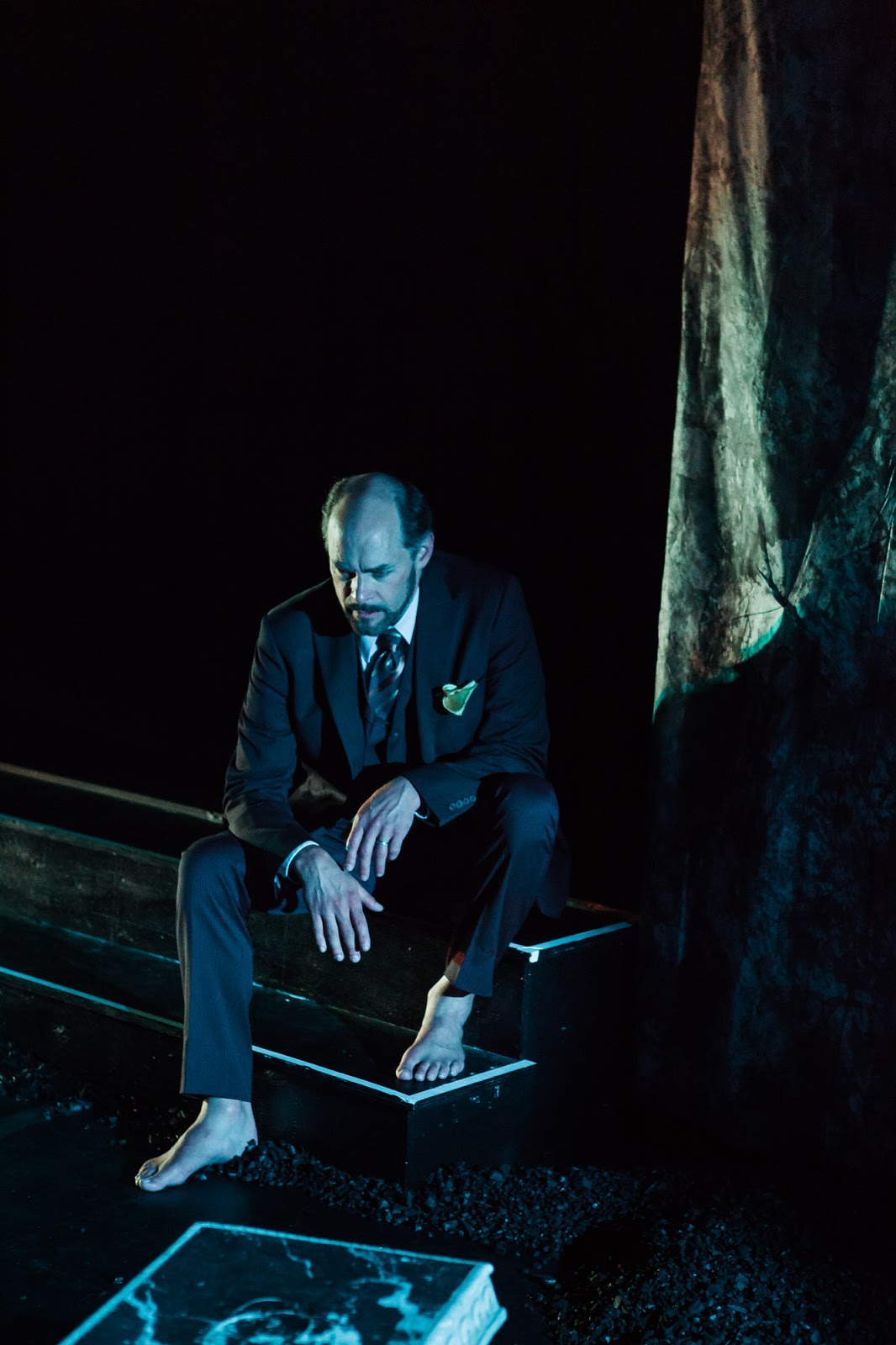
theatre KAPOW just completed its fifth production (in four years) of The Burial at Thebes, Seamus Heaney's adaptation of Sophocles' Antigone. Each year we remount our production for Saint Anselm College, as part of the College's Conversatio course for first-year students. The production helps us pay the bills for the rest of the season. Four of our company have appeared in the same roles in all five productions. Yet with some effort on all our parts, we have avoided the artistic peril.

This summer during our annual retreat at Chanticleer Gardens we dedicated five class sessions in what we called the Michael Chekhov Practicum to rehearsing just the first scene of Antigone, each day from a different starting point in the actor's art: psycho-physical center, quality of movement, atmosphere of place, expansion and contraction, rising and falling. Apart from the pure joy of exploring a great story, we learned that the first scene alone remains full of new possibilities for us. We haven't come close to plumbing the depths of the Antigone story.

A month later we began formal rehearsals for this latest production. The design and staging elements remain largely the same. But the four actors who were returning for the fifth time each found a newness in the work. Each of us had the experience of hearing or seeing something in a new way, and thus each of us could realize new relationships and possibilities. For me that was the result of a new starting point. If last year was all about what Chekhov called psychological gesture, this year began with the atmosphere of corruption, and the corruption of flesh and morals that runs through the play. That atmosphere generates an odor, an imagined sensation on the skin, and a visceral experience of corruption. That experience of the atmosphere led me to an enhanced understanding of Creon's action through the play. He's not only "saving the city;" this year he's purging the corruption, and again that action carries him from the beginning of the play to the very end. The experience of atmosphere led also to a new quality of movement - less flying this year, and more molding. And then to a new experience of psychological gesture that develops from expanding and contracting in the atmosphere. Purging is a kind of expansion; the defense against or retreat from corruption is a kind of contraction. And those new or refined gestures led further, to a new consideration of archetype. This year, Creon is not so much a king as he is a priest (who else has the work of saving the people or purging the corruption?). Antigone, in my mind, becomes a priestess, or nun, or sacrificial virgin. And thus we arrive - in fairly rapid fashion - at a deeper layering of the relationship between the two characters.

Of course we still encounter the usual troubles that plague almost every production in almost every company - too little time to rehearse, uncertainty about the receptivity of the young audience (which this year was superb), and so on. But the lesson of this year's remounting, and of all great plays, is that we never really "close" a production, or "put to bed" a great role. We've discovered that there's a lot of work left for us to explore in this story, and that as we continue to incorporate trainings with rehearsals we can avoid "the O'Neill Dilemma." Next year's Thebes won't be a mere repeating of the old chestnut for us, but the opportunity for our deepest artistic growth.

~Peter Josephson

Monday, September 1, 2014

Learning to Learn in the Present Moment

This summer was our third Artists Retreat, concluding just a few weeks ago. Why do we go there for a week each year right at the start of the season?
Continued study has always been a core tenet of our company. Eugenio Barba writes of the phenomenon he calls learning to learn. "This is of tremendous importance for those who choose or are obliged to go beyond the limits of specialized technique. It is the condition that enables us to go beyond technical knowledge and not be dominated by it." As we experience and learn from on-going theatre trainings, we wanted to share our disparate methods with one another. Peter, through a series of events and meetings only to described as synchronicity, was introduced to the owners of Chanticleer Gardens, an idyllic flower farm. So Matthew said, "Let's go to the farm all day every day for a week, share, and see what comes of it."
In addition to sharing our own methodologies of the Michael Chekhov training, psychophysical improvisation, and Viewpoints, we brought in guest artists to lead workshops in modern dance, poi spinning, Lessac Kinesensic training and more. What we discovered, and continue to discover every year, is that the similarities and commonalities among all these practices far outweigh the differences. All of them seek truth, a unity of something both inside and outside the self, which is recognizable beyond culture, medium, or even time.
For the last two years Aaron Butler, a master of several martial arts who teaches at The Training Station in Manchester, NH, led a workshop in Tai Chi and I Liq Chuan. This work became some of the most profound of the retreat for me. At the core of both practices is developing a mindfulness and awareness to the present moment. The vocabulary is different, but the ideas the practice is driving toward are familiar. Aaron's teaching reminds me that there is so much in this world that I don't know, there is so much I can learn.
This summer we had a new guest artist, Valentina Lattuada from Barcelona, Spain, who shared her work which she calls Integral Transpersonal Theatre. I prefer the alternate name she uses - the Poetics of the Invisible.  Her work began, like so much does, with a connection to the breath. Again, the vocabulry was different, but the goal a familiar unknown. Breath is one way we can check in on five levels: physical, energetic, intellectual, emotional, and transpersonal. The exercises she led each session point to that same mindfulness and awareness, and even reception of the present moment.
Just a few weeks before our retreat, I read a blog post by John Britton of Ensemble Duende about the challenge of returning to "real life" after an intensive. "Could that even be our job as artists, to help our communities (re)discover the wonder of each passing moment and the connections between us, across time and geography?" Yes, I think so. And that is why we return to Chanticleer Gardens each summer, why we meet monthly for Open Training, and why we work hard to keep learning, and keep striving to connect in the present moment.
~Carey Cahoon