Monday, May 23, 2016

Exquisite Pressure

Pressure is a central ingredient:  pressure of collaboration, of time, of putting all this stuff together...I cannot possibly control it, therefore I start to work on a more intuitive level, rather than on a logical level, which is what you are trying to get to because all creation is intuitive.
-Anne Bogart

tKAPOW spent last week in residence at Charlestown Working Theatre developing our new piece Raining Aluminum.  This process was simultaneously thrilling, terrifying, inspiring and exhausting. While we have been doing pretty heavy research on the piece for about 15 months, we walked into CWT with little more than a collection of stories we’d like to explore and a few movement sequences.

The day before we set out for Charlestown, Carey and I assembled ten brand new 4’ x 4’ platforms to act as the set (with the side benefit of being small enough to fit in the Opera House elevator for future shows) and loaded a truck full of various objects that we thought would help with the storytelling.   With Cynthia MacLeod, our musical collaborator, set to arrive that day, I spent Sunday loading in all of our odds and ends.  Just before I left CWT, I arranged the platforms and objects into what I proposed would be their starting position for the show.

Monday morning, we stopped at Cynthia’s hotel and Carey got to meet her for the first time (they became pretty close by the end of the week).  We drove down to Charlestown and discussed the plan for the day.
While Tayva and I worked on hanging a light plot (difficult to do when you don’t even have a script yet), Peter and Carey worked with Cynthia on learning a seated step dance that we planned to incorporate into the piece (it turns out that it was a remarkably effective way to start the show).  That evening we had our first rehearsal in space.  The daily schedule for the rest of the week was similar with intensive work during the day with our visiting artists on music, puppetry or text and then we’d rehearse in the evenings.  Now you probably understand the use of the word “exhausting” in the first line above.

The week culminated in three work-in-progress showings.  On Thursday, Cynthia and the music was featured; on Friday, Vit Horejs and the object work was the focus; and, on Saturday, we were able to share a full first draft of the piece that included a lot of the text developed by our dramaturg Kelly Smith (including a monologue that was re-written about 10 minutes prior to the start of the showing).  An important part of the process was the audience feedback session that we conducted each night.  It was fascinating (and occasionally surprising) to hear which elements of the piece really resonated with the audience and equally as helpful to hear what wasn’t working.  This is all feedback that we will consider as we continue to develop the piece.

By far the best part of this opportunity was that it gave us a concentrated stretch of time to experiment, work, and play.  What Anne Bogart refers to as “exquisite pressure” was definitely a major contributing factor to our work last week.  Charles Mee describes Bogart’s “exquisite pressure” in the following way:

 “[it’s] one which promotes creativity by overwhelming collaborators with a lot to do in a short amount of time so that they do not have the chance to think too much.”

We often said last week that when creating original work you might work for an hour and only find 30 seconds of useable material.  Last week we certainly did create a bunch of stuff that ended up on the proverbial “cutting room floor,” but I think the pressure of having to have something ready to share with an audience resulted in the discovery of a few pearls.  In the coming weeks, we’ll work on stringing those pearls together to create a complete piece.  The new piece will premiere at the Stockbridge the weekend of July 8-10 and then we hope it will have the opportunity to tour around a bit.  If you are interested in seeing new and non-traditional theatre, I hope that you will come check it out.

~ Matt Cahoon

Monday, May 2, 2016

How am I doing today?

Breathe.

Grounded closed yesterday, its initial run anyway. We got home after a 4-hour strike, I put the flight suit and boots away, shirt and socks into the laundry. I slept very, very soundly last night, which hasn’t been the case for the last two weeks. This morning I got up, and went through my full morning routine.

Read a chapter of Zen in the Art of Archery. Since the new year, I have started my day each day by reading 15 - 20 minutes of eastern philosophy, which has been incredibly calming and strength-building.

I spend a few minutes seeing off my husband and daughter as they head to work and school. 6 minutes of balance exercises. This six minutes every day is a great opportunity for me to check in with my body and my mind. How am I doing today? Am I steady? Am I grounded? I unroll my yoga mat, and stretch for 10 - 12 minutes. Breathe into those muscles, those joints, those hard-working tendons that need breath. Today was a return to planking in the morning. How am I doing? Do I feel strength and can I balance the tension and find relaxation?

I roll up my yoga mat, and bring up a guided vocal warm-up on my i-phone. I have been doing this vocal warm-up for almost six years now. In 2010, my husband pushed me to go to an actor training program. He researched summer programs and sent me the information on the Atlantic Acting School and said, “this is the one you need to go to.” He was right. I come back to the vocal work I learned there almost every day. I spend 10 minutes, 20 minutes or more if I have the time, breathing and generating sound. How I am doing today? Where am I feeling vibration? The warm up is different every day because I am different every day. Sometimes I spend my vocal time in the morning focused only on the breath, with very little sound. I am grateful for this time to breathe and nourish this very basic starting point for everything.

Make sure the water is heating up for my cup of tea.

I turn to another practice: speech. Working the muscles of my mouth. Tuning in to vibration and sound waking up the full range of my voice. Articulation, clear pronunciation, strength and freedom of movement to shape breath and sound to clearly communicate. How am I doing today? Am I here in this moment or just going through the motions? I spend about 16 or 17 minutes on this speech practice.

Brew a cup of green tea and let it steep.

Meditate 10 - 12 minutes. Breathe. How am I doing today? Am I here in this moment? Am I grounded?

Drink my green tea. Eat breakfast, face the day. Carry the work from the morning into the day.

I was terrified when theatre KAPOW chose to put Grounded into the season. There was a time I said, “Find someone else to do it. I won’t be able to do it.” 100 minutes on stage, just me. Lean into the uncomfortable, face the fear. I know that the only way I was able to do it was because of those daily practices. My voice did not give out, my body did not give out. Voice, speech, and most importantly breath.

I am grateful for those practices. I am grateful.

Breathe.
~Carey Cahoon

Tuesday, April 26, 2016

The Evolution of a Season - Our Relationship with Technology

It’s no secret, by now, that I’m really into season planning. At this time of year, several of us read dozens of plays and have long conversations about themes we are interested in exploring moving forward. While I’m certain some future post will be all about planning season 9, that’s not what I’m thinking about today. Rather than spending this time planning for future seasons, I find myself reflecting on season 8. No, it’s not done, there is still a lot of work to do, but as I sat to work on Grounded this morning, I found myself thinking of the show in context of the season as a whole.

If you’ve been following tKAPOW this season, you know that our theme is BREATHE. I think it’s a great theme and really touches upon both our interest in the importance of those things that make us human and the practical use of breath as a part of our training and storytelling processes. But, as I reflect on this season now that Grounded is nearly up on it’s feet, I find a different theme emerging. What I think we’ve really been exploring this season is humankind’s relationship with technology. It wasn’t planned that way and since it wasn’t planned somehow it feels more sincere. Here’s a reminder of what season 8 has looked like so far.  


In December, we produced Duncan Macmillan’s Lungs. The play centers around a young couple making deciding whether or not to have a baby. The relationship between M and W in that play is in the foreground, but one of the clear factors contributing to the couple’s (especially W’s) reluctance to have a baby is how much of an impact the child will have on the environment. Ultimately, I think everyone would agree that having the child was for the best and that M and W were able to live much happier lives as a result. At the end of the play, however, the world is literally covered in ash.


This year’s February comedy was Marie Jones’ Stones in His Pockets. Rich and Peter had a great time playing a whole bunch of different characters including members of both the local, rural Irish village a Hollywood film crew. As is fairly typical of a tKAPOW comedy, the show was funny on the surface but had some very serious undertones. At its roots, Stones explores the impact of outside modern influence on a traditional community.


With Grounded (opening this weekend at the Derry Opera House), the relationship between humans and technology is forefront. As the technology of warfare has shifted away from fighter jets and towards unmanned aerial vehicles (drones), the way we conduct war has changed considerably. So much of this show is about the guilt associated with inflicting harm without ever putting yourself in danger. The show also asks serious questions about how technology can desensitize even those in the most critical of fields. When our world is reduced to what can be seen on a small screen, what are the implications of our actions?

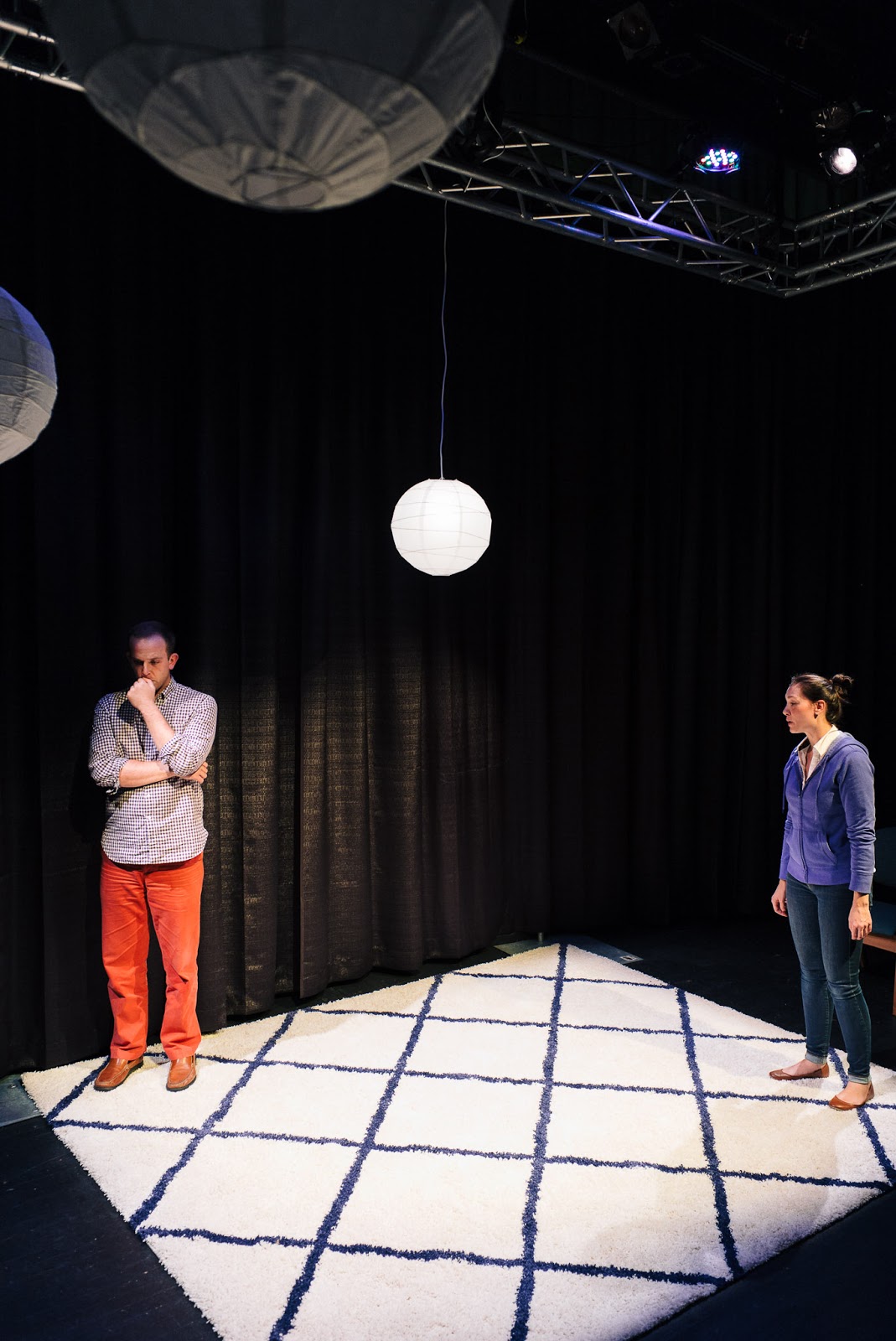
Looking back I’m really proud of the season aesthetically and think that a lot of the design elements also speak to our relationship with technology. Lungs was just two actors (wearing their own clothes), an 8’x10’ area rug, and a few Ikea light fixtures (oh and a grand total of 6 light cues). The world reduced to the minimal. The set for Stones was a physical representation of the influence of man (the rectangular platform) on nature (the circular grassy hill). David Brown provided beautiful traditional fiddle music which was contrasted by Tayva’s visible movie lighting equipment. Grounded, as you will see in just a few days, is a mess of technology. It’s as technologically complex a show we have ever done with 5 flat screens, multiple cameras, two laptops, and dozens of video clips. All of that technology is juxtaposed, however, by a single actress, in a single costume, standing in an 8’x8’ room with one very plain looking chair.

It’s fascinating to me that without really meaning to, we’ve been exploring this idea of our relationship with technology all season long. I think this speaks to the fact that amazing things can (and will) happen if you make a priority of producing well written shows and purposefully stringing together pieces that complement each other.

As we plan season nine (it’s still amazing to me that it’s already been eight years), we know that we have a responsibility to ourselves as artists, to the playwrights whose work we produce, and most of all to our audience, to continue to make deliberate choices when constructing the season. I’m excited to explore new themes in season nine and to see what conversations result.
~Matt Cahoon

Thursday, April 7, 2016

The Rock Star Power of a Book

A few weeks ago, I attended a meeting of the Arts Presenters of Northern New England, a consortium of approximately 40 arts organizations from NH, VT, and ME. The meeting was held at Middlebury College and there were almost 30 people in attendance (a larger than usual crowd for one of these meetings especially since many had a long drive). So, what was on the agenda that day that had the membership so excited? Well it happens that the meeting was scheduled at the same time that Shakespeare’s First Folio was on display at the museum on campus.
Following a bit of business during which many an arts presenter sat fidgeting in his or her seat awaiting an encounter with the Bard, we were ushered down to the museum. We met with the Chief Curator, Emmie Donadio, who spoke with us in the lobby for a few minutes about the museum’s mission and its collection. About 5 minutes into her remarks, however, she stopped and said, “but that’s not why you are all here.” We all knew that about 100 feet from where we stood, but just out of sight, sat one of the most important books we’d ever lay eyes on in person. Emmie released us like a group of school kids on the last day of school and we, distinguished professionals that we are, all practiced our best fast walk/almost run/you’re in a museum so be respectful.

At the end of the main hall was a huge sign in the shape of an open book and to its right, sat the First Folio propped up on a pedestal and under glass. Like so many people observe when they see the Mona Lisa, the folio is smaller than the reputation that preceeds it so we, very gently but very eagerly, encircled the book in such a way that we could all get a look at it. The book sat open to Hamlet, Act 3 Scene 1 and there on the right page almost at the very bottom of the page and just an inch or so from the fold in the spine were printed the words “To be, or not to be, that is the Question.” Reading those words was a moment that quickened the pulse for sure. Emmie felt that, having relieved our craving to be in the presence of the book, it was safe to spend a few minutes speaking about it and about its importance not only as storehouse of some of the most important English literature, but also as an object that represents an important period in printing. Her expertise is in rare books and it was fascinating to see how excited she was about it as a book while many of us seemed more excited about the book’s contents. If you have never done so and ever get the opportunity, I strongly encourage you to take part in a curator lead tour of an exhibition. You’ll learn more about art than you ever thought you could know.
What I found most exciting about the day, however, was the enthusiasm that all of these arts presenters had for this book under glass. I’m a theatre guy so to me it represents so much of the past, present, and future of the field about which I am most passionate. To music people, this was the book that inspired Mendelssohn and Tchaikovsky. To fine art people this book provides context for appreciating Sargent’s Lady M and Millais’ Ophelia. Opera aficionados find in the book the muse of Verdi and Wagner. It’s a great unifier. Mostly, I was so thrilled to see how giddy this book made my colleagues.
So, by now, you’ve probably figured out why I share this story.  This morning, two days earlier than the scheduled open date; the exhibition First Folio: The Book the Gave us Shakespeare became available for public viewing at the Currier Museum of Art. theatre KAPOW is thrilled to have been a part of bringing the folio to NH and we are really looking forward to taking part in many of the events scheduled around its visit. Our involvement with this project dates back over a year now.  tKAPOW took part in the application process to bring the folio to NH and took a lead role in organizing programming to accompany the visit. Now, here we are and over the course of the next few weeks you will have the chance to not only see this amazing book in person, but also geek out with us in a month long celebration of the bard. 
tKAPOW’s first public event in conjunction with the folio’s visit will take place Monday, April 11th at 7:30pm at the Derry Public Library. Carey has put together a special presentation entitled “Women and Love in Shakespeare.” This intimate evening will feature readings from several of Shakespeare’s most famous heroines. Carey will reprise two roles near and dear to her heart with passages from Beatrice and Lady Macbeth. It is perhaps a little known fact that Carey and I started dating while playing opposite each other in Much Ado About Nothing in college.  My Benedict was passable but her Beatrice totally stole the show. On April 21st at the Currier, tKAPOW will present staged readings of two scenes from Shakespeare’s plays-within-the play. First we’ll tackle the murder of Gonzago from Hamlet followed by Pyramus and Thisbe from Midsummer’s Night Dream. We look forward to taking over the Currier’s Winter Garden with this fun and high-spirited selection. On April 23rd, tKAPOW is taking part in a daylong conference of teacher workshops revolving around teaching Shakespeare in the classroom. And, pay close attention because when you go to the museum, you will hear the familiar voices of some tKAPOW regulars leading the audio tour of the exhibition. 
It’s going to be a great month with Shakespeare themed events taking place throughout the state.  I hope that you’ll take part in as much of this celebration as you can. This book that has moved the hearts and minds of artists throughout history is now sitting here in our state and still working its magic on us.
~ Matt Cahoon

Friday, February 12, 2016

When did you first fall in love with theatre?

A few years ago (and undoubtedly this year) on Valentine’s day I saw a post online asking, “When did you first fall in love with theatre?” For me, this is both a simple and a complicated question. When did I first fall in love with “doing” theatre? As a child, I put on puppet shows, made tape recording of “radio plays” I wrote, and all kinds of make-believe happened. These are all forms of making theatre. I often think that I would love to climb under a table and have it be a secret entrance to another world like it was in Kindergarten.Once the awkwardness and tension of late elementary and middle school set in, I didn’t do any kind of theatre. Not until late in high school, on the other side of the work did I start. And since then I have not stopped.


When did I first fall in love with seeing theatre? I have three memories of seeing theatre as a young person. I was enthralled by the full transformation of space and the human form at a production of CATS when I was in 5th grade. (I know, a musical, and of all things, CATS.) It was magical. in 8th grade, I remember attending A Midsummer Night’s Dream at Arena Stage. Again: magical, but a different kind of magic this time. I remember so clearly that the part of Puck was played by a woman, and she wore black and white striped knee-highs below here cut-off pantaloons. The magic of this world was created simply, by the complete engagement of the body and voice of this actor, and by the clean lines and simplicity of the costumes.


Just as you develop and grow to learn what a loving relationship is, these early experiences weren’t really love, simply crushes. As a senior in college, I saw a production of Peer Gynt by the National Theater of the Deaf. I paid $5. (Oh, student prices!) I had studied the play in class, but there is no substitute for seeing/hearing/feeling a play. And this production used light and sound in ways that I had never experienced before. It wove puppets, mask and costume into the experience in ways that I had never experienced before. (I now know this production was a collaboration with Pilobolus.) A story of searching for one’s identity that is heart-wrenching and funny, and told/shown in such a compelling way. I sat in my chair when the show ended, not wanting it to be over, not wanting to move and break the spell. Again: a kind of magic.


My love of seeing theatre is refreshed anytime I see a show that moves me, that takes my breath away and makes me lean forward in my seat. I don’t always have that experience sitting in a theatre.  But these are the experiences I want to have: to have my ideas and assumptions challenged, to question what it means to be human and to see characters, or cities, or worlds, struggle with what it means to be a community. And my love of making theatre is closely tied to those same questions and challenges. I know a show is really good when I simultaneously think, “I can never do that and I should stop doing theatre altogether” AND “I want to do that and I must keep working.”

I fell in love with theatre and I stay in love with theatre when I see good work. It inspires me to do good work.  So, when did you first fall in love with theatre?

~Carey Cahoon

Tuesday, January 26, 2016

Always finding new inspiration

Every year, I attend the Association of Arts Presenters (APAP) conference in New York. The conference is the world's largest networking forum and marketplace for performing arts professionals. Mor​e than 3,600 presenters, artists, managers, agents and emerging arts leaders from all 50 U.S. states and more than 30 countries convene in New York City for five days of professional development, business deals and exciting performances. It is always one of the most exciting weekends of my year and this year’s conference was certainly no exception.

During my stay in NYC this year, I saw over 30 performances including dance, music, theatre, and circus. I also had two faculty members and two students from Pinkerton with me and they all saw a bunch of shows on their own. I spent all day Saturday with Julia Sylvain, a Pinkerton sophomore who is very involved in the school’s dance program. In that one day alone, Julia and I saw the work of 17 dance companies. There were companies from all over the country. Some were ballet companies and one was a hip hop company, but for the most part what we saw was a lot of modern dance. Over the course of the past few years, I’ve seen so much evidence that as theatre artists we have so much to learn from modern dance. Of all the companies we saw, the one whose work resonated most with me was ODC Dance from San Francisco. Their work is visually stunning with exceptional grace and other-worldly strength. Upon returning home, I spent some time researching the company and found some very interesting parallels between them and theatre KAPOW.

According to the ODC website: “The organization was formed by Brenda Way in 1971 as a collective of artists at Oberlin College in Ohio where the name ODC originates (Oberlin Dance Collective). Adventure, a certain irreverence and the joy of moving were key ingredients to the core philosophy of our founding members. In 1976, the sixteen dancers, painters, writers, photographers and musicians of the collective bid farewell to Ohio, piled into a big yellow bus and came west to San Francisco to find a context for their artistic vision and social ideals.” Similarly, tKAPOW was founded by four of us that met doing theatre at St. Anselm College. I really love ODC’s statement about adventure and how they exemplified their commitment to adventure by packing up and moving to California. That level of courage is truly inspirational. See a video of ODC's work here.

In NY, I was able to see excerpts of ODC’s piece boulders and bones which was inspired by the work of Andy Goldsworthy and features and original score by ZoĆ« Keating, two of tKAPOW’s favorite artists. Sitting and watching a piece inspired by an artist that is often one of your inspirations and having that piece set to music by an artist whose work is often used in our training is a strange experience. Using these sources, ODC is creating beautiful dance while we look to the work of these artists when creating theatre (especially with our devised and other original work).

One of our resolutions for 2016 is to experience the work of other companies and I am so thrilled to have been introduced to this exciting company for the first time. I’m hopeful that the year will be filled with numerous other opportunities to see the work of great artists in a variety of disciplines.

~ Matt Cahoon

Wednesday, January 6, 2016

2016 Resolutions

It's that time of year: the gym is crowded, various diets and cleanses are all the rage. Everyone is "turning over a new leaf" for the new year. We thought about some things we'd like to be sure to do in 2016, and here's what we came up with:

1. Engage audiences in the process
Last season we began a series of special engagement opportunities with our donors and audience members. The process of creation is often very private, but theatre is a collaborative experience. The cycle of sharing, discussing, revising, sharing again and continuing the discussion is at the heart of the rehearsal process. We’d like to widen the circle of participants and provide a deeper experience for audience members in 2016.

2. Experience the work of other companies
Re-stocking the well is an essential part of creative life. Sometimes that means setting aside time to read a book or color in a coloring book. One source of great inspiration and fuel for the fire/desire to create good work is to see good work. Be it dance, theatre, music, or visual art, in 2016 we want to see good work and share it with others. We’ll plan a series of “field trips” to re-stock our well and inspire our creativity.

3. Train with visiting artists
Over the course of the past several years we have hosted visiting artists as part of the annual Artists’ Retreat at Chanticleer Gardens in Dunbarton and have twice hosted trainings led by visiting artists at our studio space in Manchester. In 2016, we seek to expand training opportunities in both locations. A commitment to rigorous training has been integral to tKAPOW’s work since the beginning, but we believe that a critical aspect of our future success will be learning more about different approaches to theatre making. With this in mind, tKAPOW will plan and schedule a series of pay-as-you-go training experiences for local theatre artists.

4. Provide artists with opportunities to expand their own training
As mentioned above, training is an important piece of tKAPOW’s identity. Something that we’d like to do in 2016 is to make funding available to allow artists who work with tKAPOW to take part in training with other companies or in complementary fields that we believe may benefit future tKAPOW productions. So, attend a theatre workshop, take lessons in a certain instrument, or practice circus skills as part of an aerial silks class, we hope we can help pay for it. We want to encourage our artists to gain skills that will add to future productions.

5. Incorporate music into our work more fully
Truthfully this is one of those resolutions that I put in the list every year. Working with Sandy on The Burial at Thebes and Dave on Macbeth really added a great deal of texture to those productions and we are excited to find other ways to integrate music more fully into future productions. With Raining Aluminum, the new piece that we are premiering in June 2016, we are collaborating with Cynthia MacLeod, a fiddler from PEI. It will be fascinating to see how Cynthia’s work on the soundscape for that piece influences the storytelling. I look forward to exploring ways that music can be used in new and perhaps unexpected ways to improve our work.

6. Expand our audience base by performing in new locations
In 2015, we were fortunate enough to perform in Manchester, Derry, Concord, and Portsmouth. Everywhere we went we met new people who truly enjoyed our work. In 2016, we are already scheduled to do a workshop in Boston and I look forward to finding new performance venues. In September, we met with a number of presenters from Canada about performing up there so who knows maybe we’ll be visiting Tim Horton’s instead of Dunks when we need a caffeine boost in the new year.

7. Create a “bring-a-friend” program to introduce new audiences to our work
We know that our audience members are the best advocates for our work. We hear such lovely feedback following performances both in person and online. We want to find a way that you can share tKAPOW’s shows with a friend and get some benefit out of it. Whether that is a reduced ticket for yourself, a buy-one-get-one offer, or some kind of loyalty program, I don’t know yet, but we’d love your help in introducing more people to what we are doing.

8. Increase participation in Open Training
Just today, we fell down a YouTube hole of watching clips of Wheel of Impressions from The Tonight Show. Both the musical editions and the one with Kevin Spacey (which is a master class in vocal work itself, you should watch it) reminded me that training, training, training is so essential to creating good work. Training your ear, training your voice, training your mind, training your body: these are the tools of the craft. To excel at your craft, you need to train. It’s not about having great physical prowess or building incredible strength or inhuman flexibility. It’s about training your instrument to do what you need it to do when you need to do it, so that you can get out of your own way and be in the moment. In 2016, we will continue to share the trainings we practice, and new trainings that we find.

9. Research and learn more about the world in which we live and work, approaches to theatre creation, understanding of cultures with which we are unfamiliar.

At this time of year we often spend a lot of time reading. We read a lot of scripts, yes, but we also read about different training methodologies, philosophical texts, books on textual analysis, and the occasional book that seems unrelated to anything (Banana: The Fate of the Fruit that Changed the World and I Am Malala are on the pile this year). It is part of tKAPOW’s mission to present great works of dramatic literature from across ages and cultures, but it never really feels like we have dug deep enough. The world is a big place and, the more we learn about different cultures, the more we understand the universality of the human experience. In 2016, we must travel more, read more, and meet more people who can help us tell the stories that need to be told.

10. Recommit to our aesthetic
We talk a lot about what makes a tKAPOW show a tKAPOW show and always end up back at the same place, aesthetic. So many great artists have contributed to shaping that aesthetic over the years and, in 2016, we will continue that work to define who we are as a company through the way that we produce work. Intimacy remains a key element of our aesthetic, as does accessing character through physicality, approaching all production elements artistically, and--I hope--endeavoring towards ingenuity. This is truly the work of a lifetime, an un-achievable resolution that will nonetheless remain forever a goal for this company, in 2016 and for many years to come.