Sunday, August 16, 2015

Season 8:breathe

Dream. Awake. See. Breathe.

There are so many reasons that breathe makes a fitting and wonderful theme for season 8. The Latin word spiro, to breathe, gives us the English word inspiration. And the related word spiritus means breath, the soul, vigor, that which animates life. The breath provides a return to the most basic thing that makes us alive.

Kristin Linklater gives a wonderful tip which applies to both the artistic life and quotidian life: “Do fall in love with your breathing. It's you. It's your emotions. It's your voice. It's not a machine." Frequently at our open trainings, we talk about the importance of returning to the basics of training, including voice and the breath. Season 8 will be a good season to reinforce that message and to connect respiration directly to the work on stage.

It is a very busy season with, ironically, few opportunities to come up for breath. We start off very early in September by returning to Seamus Heaney’s The Burial at Thebes for a fourth time. The production will be September 8th, 9th, and 10th at the Dana Center at Saint Anselm College. While it is a piece that we have explored a number of times, we always try to add new elements. This year we’ll be incorporating some puppetry including a brand new marionette that we had made specifically for the production by a carver in Prague.  

The first weekend of October (2nd-4th), tKAPOW will present Duncan Macmillan’s beautiful play Lungs. Lungs tells the story of a young couple living in a time of global anxiety, terrorism, erratic weather, and political unrest, who wants to have a child but are running out of time. If they over think it, they'll never do it. But if they rush, it could be a disaster. Macmillan expertly balances humor with heartbreak and really poses questions about how we can live (and love) in a world as tumultuous as ours.

For Halloween we’ll return to yet another familiar piece as we remount our award-winning production of Macbeth. Shakespeare’s famed “Scottish Play” as interpreted by three actors using minimal props and costumes. An audience member who saw the show last year commented,”The production had an amazingly guttural (raw) feel to it; the energy of the production was palpable.” This year, we’ll be taking the show to two venues where tKAPOW has never performed: Seacoast Repertory Theatre (October 29th-31st) and the Capitol Center for the Arts (November 6th).

The very popular ARTiculate playreading series at the Currier Museum of Art is now in its third year and will continue this year with two readings. The first play Bakersfield Mist by Stephen Sachs will be read December 13th. In this very funny new play, when it turns out that a thrift store gag gift may in fact be a long-lost Jackson Pollack painting, an expert is brought in to determine its authenticity. In March, tKAPOW will be reading Filming O’Keefe in relation to a piece in the Currier’s permanent collection: Cross by the Sea, Canada 1932, by Georgia O’Keefe. The play explores the relationship between O’Keefe and Alfred Stieglitz through the lens of a school project. The funny but poignant play explores the bonds of familial relationships as a teenage boy seeks to uncover his family’s hidden past.
After the success of 2013’s Penelope, tKAPOW is pleased to once again present a wonderful piece of contemporary Irish dramatic literature with Marie Jones’ Stones in His Pockets. This Olivier Award-Winning play (Best New Comedy, 2001) tells the story of a movie location shoot in Ireland, and the delightful, touching characters caught up in it. The piece is a comic tour-de-force for two actors who play all 15 roles. Not to be lost in the quick changes and ridiculous situations is a play with tremendous heart. Stones in His Pockets will be presented February 26th-28th at the Stockbridge Theatre.

In April, tKAPOW will return to the Currier for some very special events. tKAPOW, was part of a group of arts organizations and educational institutions that has come together to host a copy of Shakespeare’s First Folio. As part of the folio’s visit to NH, tKAPOW will be performing a selection of Shakespeare scenes (April 21st) and leading an educator workshop (April 23rd) at the museum.

May is a very busy month for tKAPOW. At the beginning of the month (April 29th-May 1st), we’ll be presenting George Brant’s explosive one-woman play Grounded. When an unexpected pregnancy ends an ace fighter pilot’s career in the sky, she is reassigned to operate military drones from a windowless trailer outside Las Vegas. She hunts terrorists by day and returns to her family each night. The play, which just completed a very successful New York run featuring Anne Hathaway, asks questions not only about the nature of modern warfare, but about its impact on families at home.

In mid May, tKAPOW goes on the road once again. This time we’ll be headed to the Charlestown Working Theatre in Boston to spend a week workshopping a new piece tentatively entitled Raining Aluminum. The piece weaves together the parallel storylines of the 1917 explosion in Halifax Harbor (and the corresponding American relief efforts) and refugee stories from Operation Yellow Ribbon (the Canadian response to the terrorist attacks on 9/11). While these two moments in history are often associated with great tragedy, Raining Aluminum seeks to highlight the tremendous instances of gratitude and the strength of human spirit. We are so thrilled to be collaborating with some fabulous artists on this project including the Czechoslovak American Marionette Theatre and world renown PEI fiddler, Cynthia MacLeod. The piece will be workshopped in Boston May 15th-21st in advance of the world premiere production at the Opera House in Derry June 24th-26th.

It will be a very busy season and one full of great theatre. In the words of the Buddhist monk, Thich Naht Hanh, “Smile, breathe, and go slowly.” A mantra for this busy season indeed.

Tuesday, June 9, 2015

From Brazilian Page to American Stage

It is not rare for theatre KAPOW to work with pieces in translation.  In fact, a quick count reveals that nine of our mainstage shows over the past seven seasons have been English translations/adaptations of pieces originally penned in a different language.  So, I think we’ve become pretty adept at interpreting foreign text for American audiences.  What we have never done, however, is play an active role in translating and adapting a piece for the stage.  That’s exactly the challenge we find ourselves facing with our current project, Uma Vida Imaginária (An Imaginary Life). 
How the text ever got to us in the first place is quite an amazing story.  Just over a year ago, our dear friend and collaborator Valentina Lattuada introduced me to Nick Farewell, a novelist currently living and working Sao Paulo, Brazil.  Nick, whose birth name is Gye Suk Lee, was born in South Korea and emigrated to Brazil when he was 14.  Nick’s parents were determined that he would assimilate to his new culture so he started using the western name Nicholas.  He says he learned Portuguese by playing ball with his school friends.  After starting a degree in Mechanical Engineering, Nick changed paths and decided to go into advertising.  He is now one of Brazil’s most well-known authors.  His best-selling book Go was selected for inclusion in the Brazilian public school curriculum and is such a cultural phenomenon that it has led to young people throughout Brazil getting the book’s title tattooed on themselves.
It was another of Nick’s books (Uma Vida Imaginária), that Valentina told me renewed her own faith in the redeeming power of love.  When Nick agreed to allow us to adapt his book for the stage, Valentina and I jumped at the opportunity.   That process started in earnest in August 2014 when Valentina travelled to NH to lead some training as part of theatre KAPOW’s annual summer artists’ retreat.  Carey, Peter, Valentina and I worked with local Brazilian actor Rafael Marinho to start the arduous process of making Nick’s words performable.  This was some of the most rewarding work of my life in the theatre.  Listening to Valentina and Rafael work through the language and then working with them to help take the literal translation and make it sound more natural was invigorating.
That week of work in August provided us with a rough draft of a script, but we knew that it still needed a lot of work.  Our next step was to send the script to our good friend and well-respected NH playwright Lowell Williams.  Lowell went through the script for us and found all the things that he thought needed to be re-worked.  One scene that provided us with a particularly difficult time (scene 10 in the show for those who may want to keep track) just didn’t seem to work in English.  In the scene the two characters are having trouble communicating because one is misinterpreting what the other is saying.  We really thought that the only way to make it work was if we kept the joke in Portuguese.  Then we decided to turn to two more of our longtime collaborators Mark Marshall and Kyp Pilalas from Wax Idiotical Films.  Mark and Kyp are two of the funniest guys I know and their films have a trademark quick wit.  They puzzled over the scene and within just a few days sent us a re-write that is absolutely one of my favorite parts of the show.  They just did such a tremendous job remaining loyal to Nick’s words while also finding a way to make the scene work for an American audience.
Now we’re in rehearsal for the show and every night we find little things we want to tweak.  It’s a process to be sure and one that likely isn’t going to be finished until the lights come up on opening night.  We are anxious to share that moment with you and especially excited that Nick will be there to share it with us.  From Korea to Brazil to New Hampshire I can’t imagine what it will be like for him to watch his words come to life on stage at the Opera House.  Man, now I’m psyching myself out.  There’s lots of work left to do before you and Nick arrive. Gotta go.

  1. ~ Matt Cahoon

Thursday, April 9, 2015

Strings and Things, and the power of puppets

If you’ve spoken to me at all in the past couple of years, you probably have heard me go on about how I went to Italy to take part in the International Symposium for Directors that LaMaMa runs out of a renovated convent in Spoleto, Italy.   It was a magical experience as training so often is.  As an artist, I believe that there is no better gift you can give yourself than spending a couple of intensive weeks immersed in your craft.  Perhaps that’s a soapbox for another blog, or you could just go back and read Carey’s brilliant blog on the topic from a few years ago here.
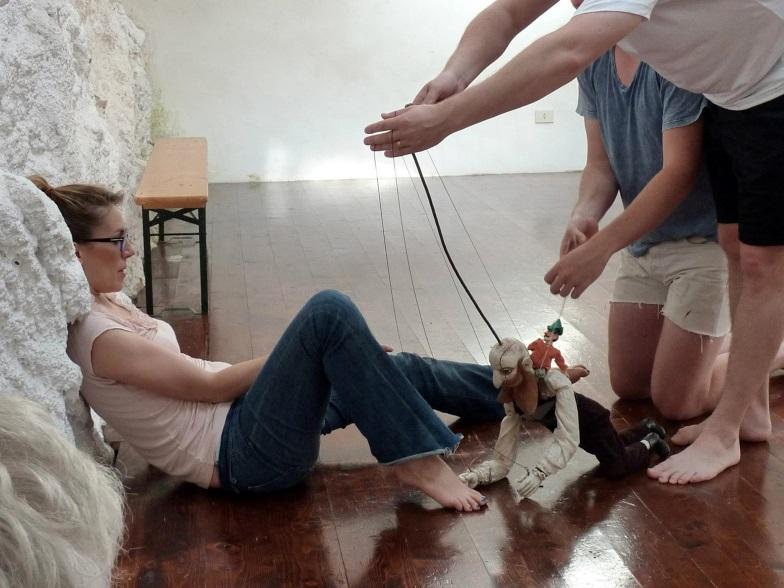
https://scontent.xx.fbcdn.net/hphotos-xap1/t31.0-8/1172671_10101649417935190_897024912_o.jpgTwo of the artists that I had the privilege of working with at the symposium were Vit Horejs and Bonnie Stein from the Czechoslovak American Marionette Theatre.  Prior to my experience in Italy, I had done very little work with puppets so I was excited-- if not mildly apprehensive --about what laid in store for me.  Vit and Bonnie are two of the most kind, gentle, and generous artists with whom I have ever worked.  I remember walking into the studio filled with marionettes of all different sizes (from very small 5” puppets to pretty tall 30” puppets).  We started class as we started so many classes that summer by doing a series of stretches.  I can honestly say that it only took about ten minutes attempting to manipulate the puppets before I realized why all that stretching was necessary.  Supporting the weight of a 30” puppet, while also manipulating him at least somewhat realistically, is incredibly difficult work.  Vit and Bonnie’s classes were 4 hours long so after class you could find all of the participants with dead arms and wrists and sore backs.
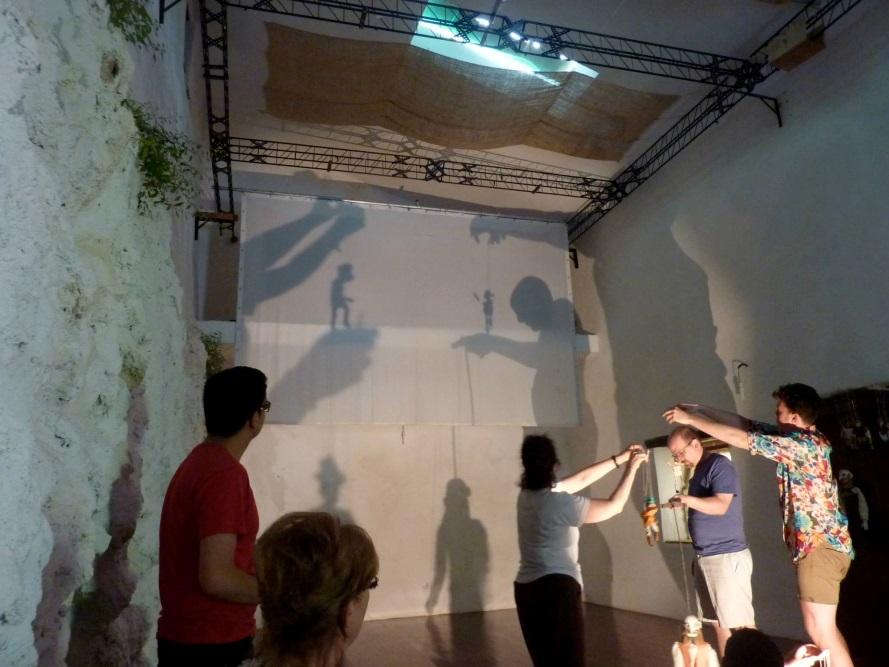
It wasn’t until the middle of the week, however, that I learned how mentally taxing the work could be.  Vit was developing a new marionette piece based on The Republic by Plato that was to premiere at LaMaMa in the fall (you can read the NY Times review here).  For the piece, Vit wanted to explore characters played by actors, by marionettes, and by shadows.  I have yet to experience anything as mind-blowing as trying to juggle not only my own movement and my marionette’s movement but also my shadow’s movement and my marionette’s shadow’s movement (hurts my heard just remembering it).  All of this, mind you, while incorporating text from Plato, not exactly Dick and Jane.  The classes were mentally and physically exhausting, but the rewards were great (I will never forget the eruption of applause from our group the first time one of our colleagues managed to get a marionette to turn a page in a book).  The class that I think I looked forward to the least ended up being the one with the most profound impact on me.  https://scontent.xx.fbcdn.net/hphotos-prn2/t31.0-8/1090967_10101649425954120_26152586_o.jpg
So, it is with tremendous excitement that I announce that Vit and Bonnie will be the featured guest artists during theatre KAPOW’s Artists’ Retreat this July at Chanticleer Gardens in Dunbarton.  They will be bringing some marionettes for us to work play with (I have to admit that I think I am as excited about being reunited with some of my old wooden friends as I am about seeing Vit and Bonnie) and will be working with tKAPOW on object manipulation for a new project that we are developing over the course of the 2015-2016 season (stay tuned!).  This year’s retreat will be July 12th-18th (yes, earlier than in years’ past) and in addition to Vit and Bonnie’s workshops we are planning on a line-up of really fabulous classes throughout the week.  I will spend my spring dreaming of the lush gardens and grounds of Chanticleer Gardens and looking forward to the day when I can bring one of my marionette friends on a kayak ride around the pond.  I really hope that you will set aside some time this summer to come out and immerse yourself in some wonderful work.
- Matt Cahoon

Wednesday, March 4, 2015

Exquisite Clutter in a New Space

I want to lead the Victorian life, surrounded by exquisite clutter.
-Freddie Mercury

Were he still alive, I think Freddie Mercury would appreciate theatre KAPOW. He would love the work, certainly (clearly the man had a flair for the dramatic), but I’m sure he’d also appreciate our “exquisite clutter.” For seven years now, tKAPOW has been accumulating stuff. I’m reminded of Peter’s performance this past weekend in our most recent production, Russian Roulette and Parisian Poker, when his character, Ivan Ivanovich, in describing the perils of summer life in the country exclaims, “Have you ever tried to make a single package out of twenty bottles of beer and a bicycle?” Well, I ask you, have you ever considered what it’s like to fill your attic and basement with two settee sets, 38 chairs, and five speedos (little known fact: one of the guys in Penelope actually had a back-up speedo)? Not to mention the masks from Agamemnon/Thebes, the leotards from The Birds, the garden arches from Is She His Wife?, the prosthetic leg from Buried Child, the cast iron stove from Hedda Gabler, the yoga ball from Circle Mirror Transformation, the hoof pick from Desdemona, and hundreds of other costumes, props, and set pieces (some of which have yet to have their tKAPOW debut). Well, I am so happy to announce that all of that stuff has vacated the premises on Orange Street and has found a new home at tKAPOW’s studio and storage space at 52 Garvins Falls Road in Concord. This is a momentous occasion for the small company that started in our living room.

While our own daughter is only in middle school, it kind of feels like our tKAPOW child has moved off to college and taken the contents of his room with him. The space in Concord is really special and we hope it will serve the needs of tKAPOW for many years to come.  In addition to gaining over 1,200 square feet of storage for all the clutter we have accumulated over the years, we are converting one of the rooms into a 1,000 square foot studio space that will give tKAPOW dedicated rehearsal space for the first time in our history. But -- and this is important -- have no fear, while our stuff may be going off to Concord, we are still very much committed to the audiences we have built in and around Derry and Manchester. We do have some plans in the works to expand our programming north and east of our current home base, but all of our mainstage shows will still be at either the Stockbridge Theatre or the Derry Opera House next season.

The Concord space offers us more freedom and more flexibility.  First, it frees up space in the Cahoon household, and second, it allows us the luxury of longer rehearsal blocks, ready access to rehearsal props and furniture, and the ability to work with new artists. Sometime in the near future (perhaps when it is a little warmer outside) we’ll invite everyone up to see the new space and to dream alongside us about what this space might mean for the future of tKAPOW. It will also be a great opportunity to see all the items we have collected over the years and maybe to relive some favorite tKAPOW moments. This big move would not be possible without the support of all of our audiences and donors. This support of tKAPOW over the years has been encouraging and inspiring and without it we would not be the company that we are today.


Moving forward, there will be even more ways to be involved in what’s happening at tKAPOW. As we get comfortable in our new space, I know that we’ll need help sorting and cataloguing props and costumes, painting the walls of the studio, installing track lighting and other such housekeeping that we never really had to worry about before. Please let me know if you are willing to share your talents and time to kick off this new phase in tKAPOW’s history in the best way possible. I’ll promise you that you’ll get to experience Freddie Mercury’s Victorian life when you find yourself surrounded by seven years of tKAPOW’s “exquisite clutter.”


-Matt Cahoon

Wednesday, January 28, 2015

The Necessity of Theater


Over the past few weeks, I have been reading The Necessity of Theater by Paul Woodruff. An excellent philosophical text, it challenged me to rethink what I define as theater, and what I define as good theater. Among other wonderful points, Woodruff asserts that theatre - the experience of watching and being watched - develops empathy. As watchers of good theatre, we are drawn to stories of characters that engage our emotion. This is not limited to “good” characters as opposed to “evil.” The capacity to pay attention to others for their own sake, is the basis of good ethics. This, he concludes, is what makes theatre necessary in our world. We practice the capacity to pay attention to others for their own sake, or more simply, to care about others. “When truth is spoken in theater, theater can show us what it is like to be the person who believes this truth.”

I am an avid reader of texts about theatre, acting, and performance technique, and a reader of plays. In The Necessity of Theater, Woodruff reminds me that reading a script, a “literary study”, is not the same as seeing a production. It is a valuable experience, but a very solitary one. In a similar way, the primary difference between theatre and film or television is the exchange of energy between actors and audience. The words on the page are stagnant, the carefully designed point of view of the film never changes. A script may be printed and notated, but for any given performance, the community of actors and audience members gathered in that place and in that moment of time is unique. The performance is ephemeral and is a unique yet shared experience. From this comes the value, the necessity of theater.


I am a theatre artist who believes in the importance of training, of practice. How can I “train” the capacity for empathy, for caring for others? How can I practice the crucial capacity for understanding and connection, and therefore for community? One of my goals for this year is to see good work more often, and thereby to develop the skills of being a good watcher, an active and engaged audience member. I believe that this will make me a better artist, and a better human being.
~ Carey Cahoon

Sunday, December 28, 2014

Back to basics

My daughter’s dance school posted this thought a few weeks ago: “Beginning dancers prefer to take Intermediate Level classes; Intermediate dancers prefer to take advanced level classes; Advanced level dancers take private lessons to work on the basics.”


This quote stuck with me and I have been thinking about it a lot over the last three months. The process of studying, learning, exploring, and creating our production of Macbeth was incredibly daunting and humbling. I often felt myself lost in the complexity of Shakespeare’s language, character and story; and having to keep up with my fellow ensemble members.


When I finally had time to catch my breath between the first production and the re-mount, I pulled a book off my shelf to re-read: The Practical Handbook for the Actor. It doesn’t take long to read the book, but I have underlined so very many things in it. I pulled out the notebook from my summer at the Atlantic Acting School, and laughed to look through all the attempts to analyze the short scenes we were working with in our classes.  Pages and pages of Literals, Wants, Actions, and As-ifs; crossed out, re-drafted, written over again with a different word choice. I scrapped the analysis I had settled on for the performance of Macbeth, and started the process all over again, only to go back to what I had before.  It is so complex, but so simple.


Around the same time, my mother-in-law gave me two books by Cicely Berry for my birthday. Coincidentally, Voice and the Actor is on the list of recommended reading at the back of Practical Handbook. Somehow, I had never read her work, but am finding as I read that it really resonates (pardon the pun) with me right now. For several weeks during this very busy fall, I had gotten away from my routine of daily voice and speech practice. Even when I had been doing those practices, I found myself going through the motions and not working with awareness and attention. For the last ten days, I have allowed myself the luxury of at least five minutes every morning just to breathe. With all of my energy and attention focused on just that.  It is so complex, but so simple.


I’ll slowly start a return to my full vocal practice, getting into more detailed work, playing with new-to-me texts and exercises.

But for now, I am more than happy to take the time to work on the basics.

~ Carey Cahoon

Wednesday, October 29, 2014

Finding the familiar and facing the fear

Recently, theatre KAPOW was asked to collaborate with the NH Philharmonic on a program they were doing called Shakespeare Lives! The show featured pieces of classical music by some of the best composers of all time, including Tchaikovsky, Mendelssohn, and Verdi. The pieces all had one thing in common: they were all inspired by the plays of William Shakespeare. tKAPOW was asked to read some selections of text throughout the concert. Peter, Carey, and Olivia provided the audience with wonderful context for the pieces of music and it was a really amazing concert. While sitting there watching the show, I was struck by a couple of things. First, I was surprised by how much of the music I recognized though I was previously unaware of its connection to the bard (Mendelssohn’s Wedding March from A Midsummer Night’s Dream being the best example). Second, I found it incredible that so many pillars of classical music were inspired by the works of Shakespeare. What does it say about how great the work of an artist is when Tchaikovsky is inspired by it?


The opportunity to take part in this concert was particularly synchronistic as we are currently working on our first foray into Shakespeare in the mounting of Macbeth. Approaching any Shakespearean text, but perhaps more Macbeth than any other, you have the feeling of treading on hallowed ground. This is a work that has inspired (and terrified) generations throughout the world. One of the things that can be intimidating about this play is that you encounter one of the most iconic lines of text ever written at each turn of the page. Upon first reading, or first re-reading after a long time, it’s easy to have an experience similar to the one I had listening to those famous pieces of music. You come across a line and think “Ah, so that’s where that is from.” I find it fascinating that so much of Shakespeare’s language has transcended the plays in which it was first written. His quotes, in many cases, are more popular than his plays (Perhaps we should change the marketing for the show to read “Come see an actor deliver the famous ‘Tomorrow and tomorrow and tomorrow’ speech!”). When you study this play closely, you find not only those famous lines but a number of sayings that have taken root as part of our common parlance. Without Macbeth, we’d have no “be-all and end-all,” no “one fell swoop,” no “sorry sight,” and, perhaps most tragically, no “Knock, knock! Who’s there?” It’s obviously no secret that Shakespeare was a great wordsmith, but it’s the way he brings the language together in such an incredibly efficient and compact way that makes Macbeth stand apart from so many great plays.


We are in tech week for the show and that means that we are within just a few days of sharing our work with audiences. We do so with an understanding that this production is one in a long line of productions that trace their way all the way back to the tip of Shakespeare’s quill. tKAPOW’s production uses only three actors to play all the roles in the play. We did this not to try to “do something new” (when it comes to Macbeth, everything new has already been done), but to place emphasis on the story. Our production features three storytellers aware of their place in the storytelling process. They take on their roles in view of the audience using just a few simple props and actively include the audience in the telling (don’t worry, you won’t be asked to murder anyone). While a big cast outfitted in period Scottish costumes playing on a realistically painted castle set may be nice, we opt instead to bring you a production with a little less “sound and fury.” What you’ll see is three actors at the top of their game sharing one of the greatest stories ever told. We can only hope that our production will inspire the next great symphony.
Photo by Matthew Lomanno

~ Matt Cahoon