Showing posts with label LaMama. Show all posts

Monday, August 22, 2016

Theatre as a Universal Language

Some of my favorite theatrical experiences as an audience member have been shows performed in languages other than English. As I've discussed in a previous blog, Teatr Zar, a Polish company that performed at Charlestown Working Theater a few years ago, put on one of the best pieces I've ever seen. I've been fortunate enough to see shows in Italian, French, Farsi, and ASL (which I'll grant included lots of English). In all of these cases, the power of the performances have had the ability to transcend the language barrier. It takes a special performer to bridge the gap of understanding, but when they are able to do so the results are profound. I suppose this is a reality with which opera fans are quite familiar.


As I write this, I'm on a plane back from Italy where I have spent the last 9 days in residence at LaMaMa Umbria International. I was last in Italy in 2013 for LaMaMa's Directors' Symposium. This time I was in Italy directing an original, one-woman piece entitled Bea and Me. The piece was written and performed by Marybeth Berry, a friend I met during the 2013 symposium. The show explores Marybeth's personal life story dealing with domestic abuse at the hands of her husband who died of cancer. As a means of unlocking this story, Marybeth wrote the piece as a conversation with Beatrice Herford an early 20th century monologist widely recognized as a pioneer of solo performance. The play deals with complex themes and features an equally complex format. We spent most of our time in Italy refining the script so as to improve flow, timing, and message. The piece was performed twice at Cantiere Oberdan, the host venue for the LaMaMa Spoleto Open.

About mid-week, one of the organizers of the LaMaMa program asked us how we were going to address the language issue for Italian audiences. Honestly we were so heavily involved in script edits and staging rehearsals that we hadn't really considered that at all. I reached out to an Italian friend of mine for help, but with time so short, the decision was made to just present the piece in English. We figured that if nothing else, the playwrights currently working at LaMaMa (a group of about 12) would come to the show and the language would not be a problem for them.

Friday night, the night of the first performance, came and we only had four people in the audiences, all Italians (some with very limited English). I gave my curtain speech and had the first in my lifetime experience of having to pause while it was translated for the audience. Marybeth pressed forward with her piece and the audience was absolutely enthralled. As a side note, I've never seen an actress embrace having an audience to play for as much as Marybeth did that night. Her story burst forth from her as if it just needed to be released. The performance reached its end, the lights dimmed, and our little Italian audience absolutely went nuts. They clapped and clapped and then clapped some more. It was clear that while they may not have understood all of the language (or Marybeth's crazy accent which is two parts South Carolina drawl with one part Rhode Island speed), but they were moved. They were moved because Marybeth was moved. The emotional tension in the room was evident and it needed no translation.

Here I am,somewhere over southern France and I find myself contemplating what lessons from this experience I can take with me to my work at home. tKAPOW has always been committed to producing the very best of dramatic literature and that commitment will not change any time soon. What I believe I will continue to explore as a director, however, is performance that is highly expressive and storytelling propelled by strong imagery. I will challenge my actors to consider those audiences members who may not be able to rely on understanding of the language alone. I hope that this approach will help us create productions capable of transcending language all together.

~ Matt Cahoon

Thursday, April 9, 2015

Strings and Things, and the power of puppets

If you’ve spoken to me at all in the past couple of years, you probably have heard me go on about how I went to Italy to take part in the International Symposium for Directors that LaMaMa runs out of a renovated convent in Spoleto, Italy.   It was a magical experience as training so often is.  As an artist, I believe that there is no better gift you can give yourself than spending a couple of intensive weeks immersed in your craft.  Perhaps that’s a soapbox for another blog, or you could just go back and read Carey’s brilliant blog on the topic from a few years ago here.
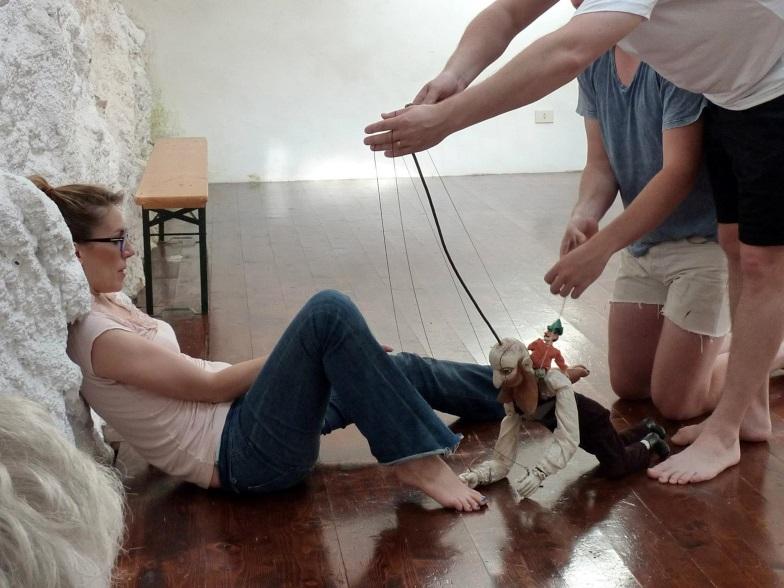
https://scontent.xx.fbcdn.net/hphotos-xap1/t31.0-8/1172671_10101649417935190_897024912_o.jpgTwo of the artists that I had the privilege of working with at the symposium were Vit Horejs and Bonnie Stein from the Czechoslovak American Marionette Theatre.  Prior to my experience in Italy, I had done very little work with puppets so I was excited-- if not mildly apprehensive --about what laid in store for me.  Vit and Bonnie are two of the most kind, gentle, and generous artists with whom I have ever worked.  I remember walking into the studio filled with marionettes of all different sizes (from very small 5” puppets to pretty tall 30” puppets).  We started class as we started so many classes that summer by doing a series of stretches.  I can honestly say that it only took about ten minutes attempting to manipulate the puppets before I realized why all that stretching was necessary.  Supporting the weight of a 30” puppet, while also manipulating him at least somewhat realistically, is incredibly difficult work.  Vit and Bonnie’s classes were 4 hours long so after class you could find all of the participants with dead arms and wrists and sore backs.
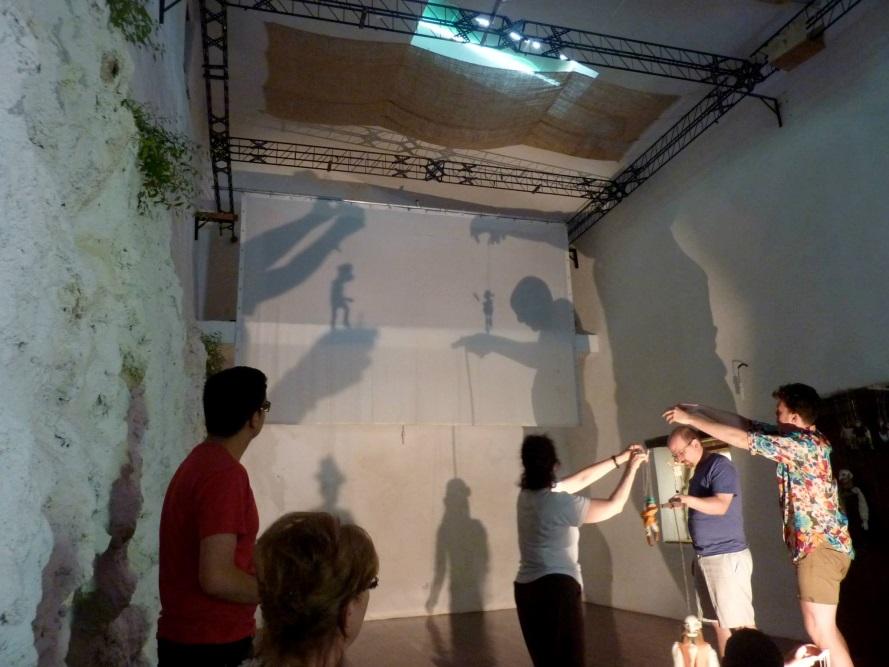
It wasn’t until the middle of the week, however, that I learned how mentally taxing the work could be.  Vit was developing a new marionette piece based on The Republic by Plato that was to premiere at LaMaMa in the fall (you can read the NY Times review here).  For the piece, Vit wanted to explore characters played by actors, by marionettes, and by shadows.  I have yet to experience anything as mind-blowing as trying to juggle not only my own movement and my marionette’s movement but also my shadow’s movement and my marionette’s shadow’s movement (hurts my heard just remembering it).  All of this, mind you, while incorporating text from Plato, not exactly Dick and Jane.  The classes were mentally and physically exhausting, but the rewards were great (I will never forget the eruption of applause from our group the first time one of our colleagues managed to get a marionette to turn a page in a book).  The class that I think I looked forward to the least ended up being the one with the most profound impact on me.  https://scontent.xx.fbcdn.net/hphotos-prn2/t31.0-8/1090967_10101649425954120_26152586_o.jpg
So, it is with tremendous excitement that I announce that Vit and Bonnie will be the featured guest artists during theatre KAPOW’s Artists’ Retreat this July at Chanticleer Gardens in Dunbarton.  They will be bringing some marionettes for us to work play with (I have to admit that I think I am as excited about being reunited with some of my old wooden friends as I am about seeing Vit and Bonnie) and will be working with tKAPOW on object manipulation for a new project that we are developing over the course of the 2015-2016 season (stay tuned!).  This year’s retreat will be July 12th-18th (yes, earlier than in years’ past) and in addition to Vit and Bonnie’s workshops we are planning on a line-up of really fabulous classes throughout the week.  I will spend my spring dreaming of the lush gardens and grounds of Chanticleer Gardens and looking forward to the day when I can bring one of my marionette friends on a kayak ride around the pond.  I really hope that you will set aside some time this summer to come out and immerse yourself in some wonderful work.
- Matt Cahoon

Sunday, September 21, 2014

A shrinking and growing world


We live in an ever shrinking world and yet the more it shrinks the more our understanding seems to deepen. It’s a world where technology has made it so that at the touch of a button we can communicate almost instantaneously with someone thousands of miles away. With just a few keystrokes we can translate text from almost any language into our own in the time it takes a webpage to load. In this time when access is at its peak, sincere cultural exchange is critical.

A number of productions have informed my desire to achieve work that transcends language and culture (notably National Theatre of the Deaf’s Peer Gynt and Teatr Zar’s Caesarian Section), but it wasn’t until I trained with Double Edge Theatre that I actively sought out ways to incorporate multiple languages into tKAPOW’s work. My summer with DET was focused on intense training that was led in relation to the company’s exploration of Homer’s Odyssey. Early on in my time there, I was taught a series of Bulgarian folk songs. What did these songs, I wondered, have to do with the Odyssey? As we neared the end of the intensive, we started to use these songs in our etude work and the answer became clear. The language didn’t matter; it was the storytelling that was important. A Bulgarian folk song made a perfect sea shanty for Odysseus’ sailors. This was an important realization for me and it has shaped much of my work since then.

Last July, I took part in the International Symposium for Directors at LaMaMa Umbria is Spoleto, Italy. Participants from throughout the world took part in two weeks of workshops, attending shows, and many late-night discussions in the gorgeous Italian countryside. There, I first met Valentina Lattuada, a theatre artist of Italian and Brazilian heritage who is currently residing in Barcelona. Valentina and I worked on a couple of pieces while in Italy and quickly realized that, despite our cultural differences, we shared a common theatrical aesthetic. Before leaving Italy, we decided that we wanted to collaborate on a project that would cross the barriers of distance, language, and culture.


In January of this year, Valentina made her first visit to NH to lead an open training and to continue our discussion of potential collaborative projects. Not long after Valentina returned to Barcelona, she was contacted by her friend, Nick Farewell, a Korean-born Brazilian author who was interested in having one of his novels adapted for the stage. After reading it, we knew that Uma Vida Imaginária would be the perfect piece for collaboration, and decided to premiere it in June 2015. To accomplish that, we knew that we’d need to find away to overcome the boundaries of language and culture, but most importantly distance. In August, Valentina came to NH again for our Artists’ Retreat and then a week of work developing the text for Uma Vida Imaginária.

The only missing piece was finding a second Portuguese speaking actor to help develop the script so that it remained faithful to Nick’s novel but also resonated with an American audience. We were so blessed to find Rafael Marinho, a Boston-based Brazilian actor to do this work with us. So, for four days Carey, Peter, Valentina, Rafael, and I worked through the text and really started exploring the beauty of Nick’s writing There were lots of fun moments (the Pulp Fiction-esque realization that Brazilians don’t use the term “quarter pounder with cheese”) but more often than not we found that Nick’s characters, themes, and words transcended language and culture.

This month, we’ve already had two conversations over Skype to continue the planning and the work we started this summer. As these calls and text conversations continue throughout the year, we’ll continue to be in awe of the way that our as world is shrinking our understanding of it continues to deepen.

~Matt Cahoon